

Gas prices aren’t the only expense taking a bite out of gig workers’ earnings. A new report from our partners at Gridwise Analytics looks at another major, and surprisingly chunky, line item baked into the price of a ride: insurance.
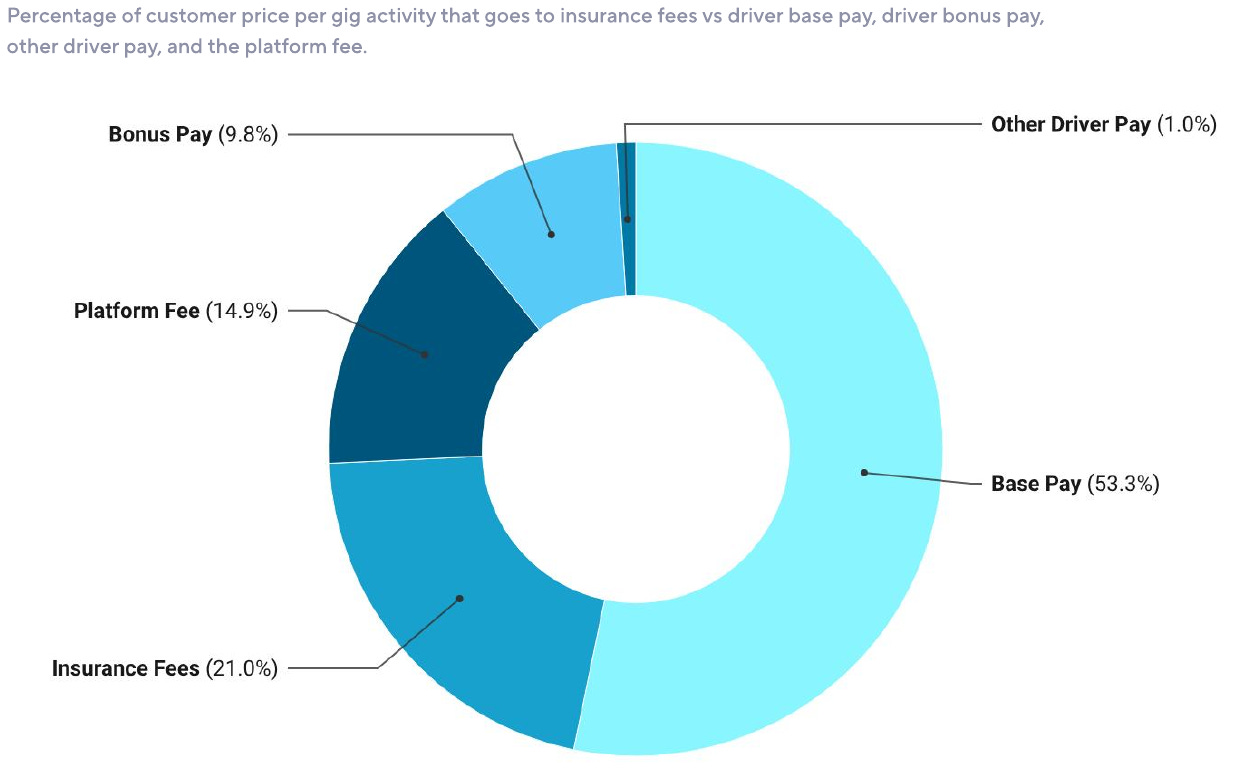
Just how substantial is it? Insurance accounts for 21% of the average Uber or Lyft fare, according to Gridwise’s analysis, compared with 14.9% for the platform fee. Driver base pay is 53.3%, with bonuses and other driver pay making up the balance. Put another way, more than one out of every five dollars that a rider spends is put towards insurance before the driver or platform gets its cut.
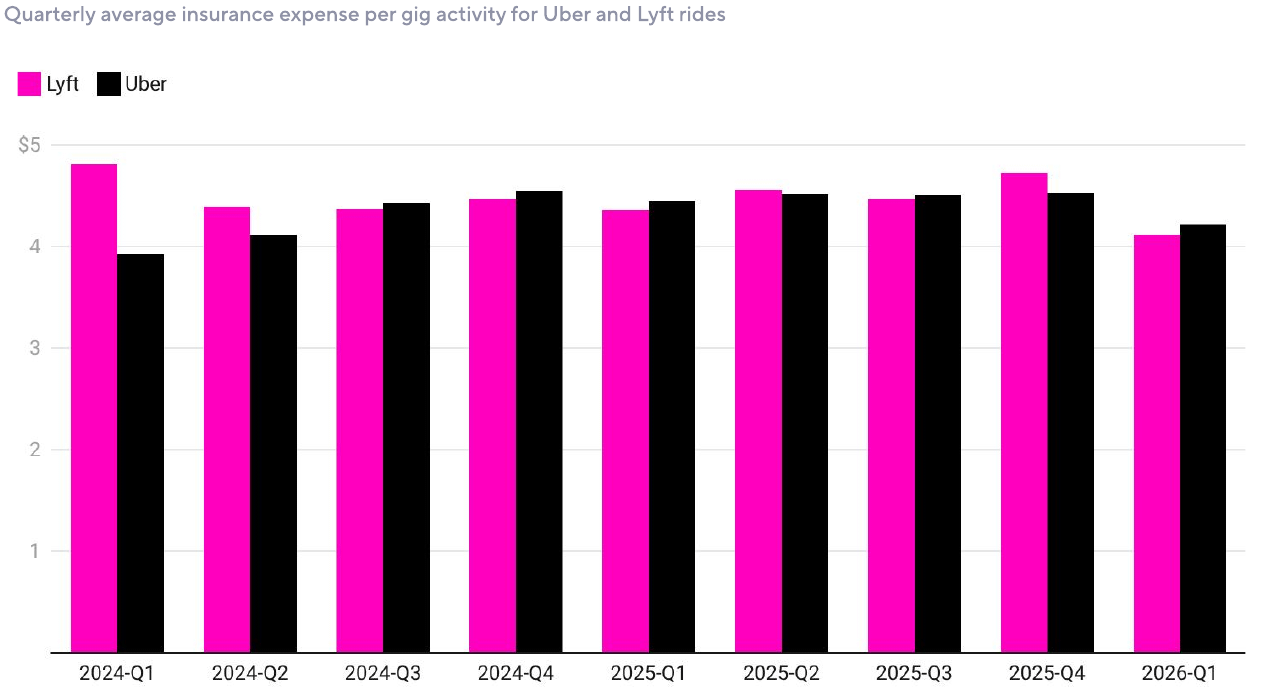
The good news is that coverage costs are finally starting to trend downwards. From Q1 2025 to Q1 2026, average insurance expense per ride fell 5.1% on Uber rides and 5.5% at Lyft. The two companies now move in near lockstep, suggesting this is less about platform-specific changes and more about broader dynamics in the insurance market.
Delivering A Lighter Load
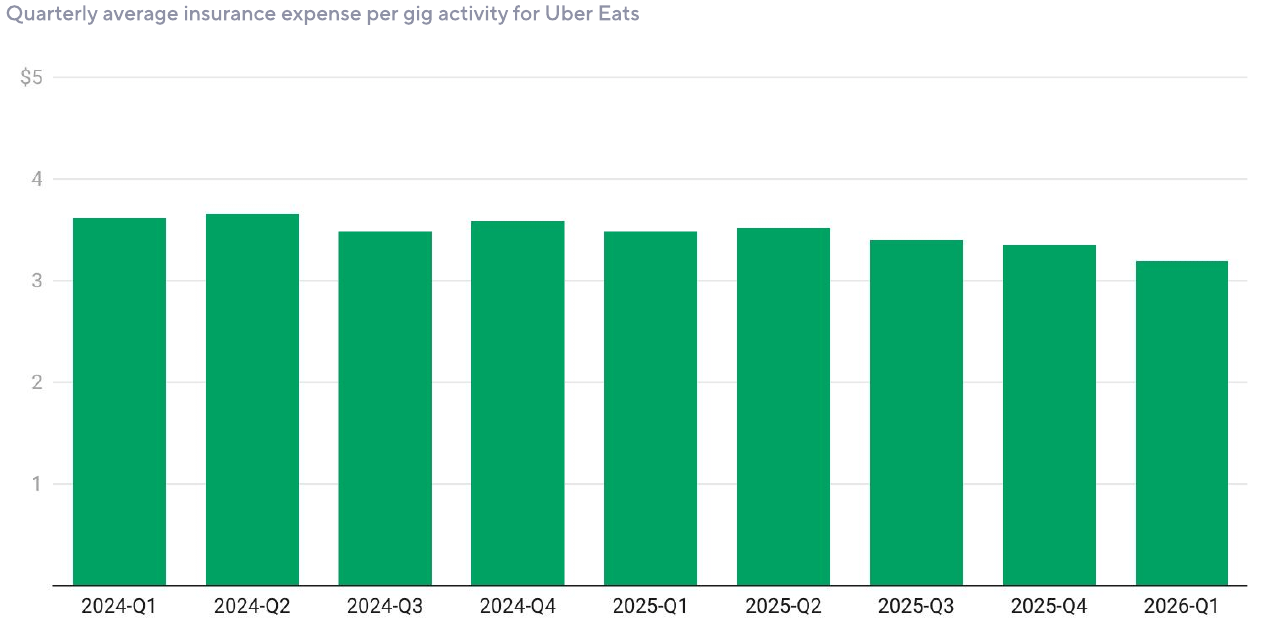
Delivery workers face the same basic insurance squeeze, but on a smaller scale. An Uber Eats job carries a lower insurance expense than a passenger trip, unsurprising given that distances are generally shorter and don’t involve the risk of another human sitting in the vehicle. These expenses are actually falling faster: the average Uber Eats insurance costs dropped 8.3% from Q1 2025 to Q1 2026 and have been trending downward since 2024.
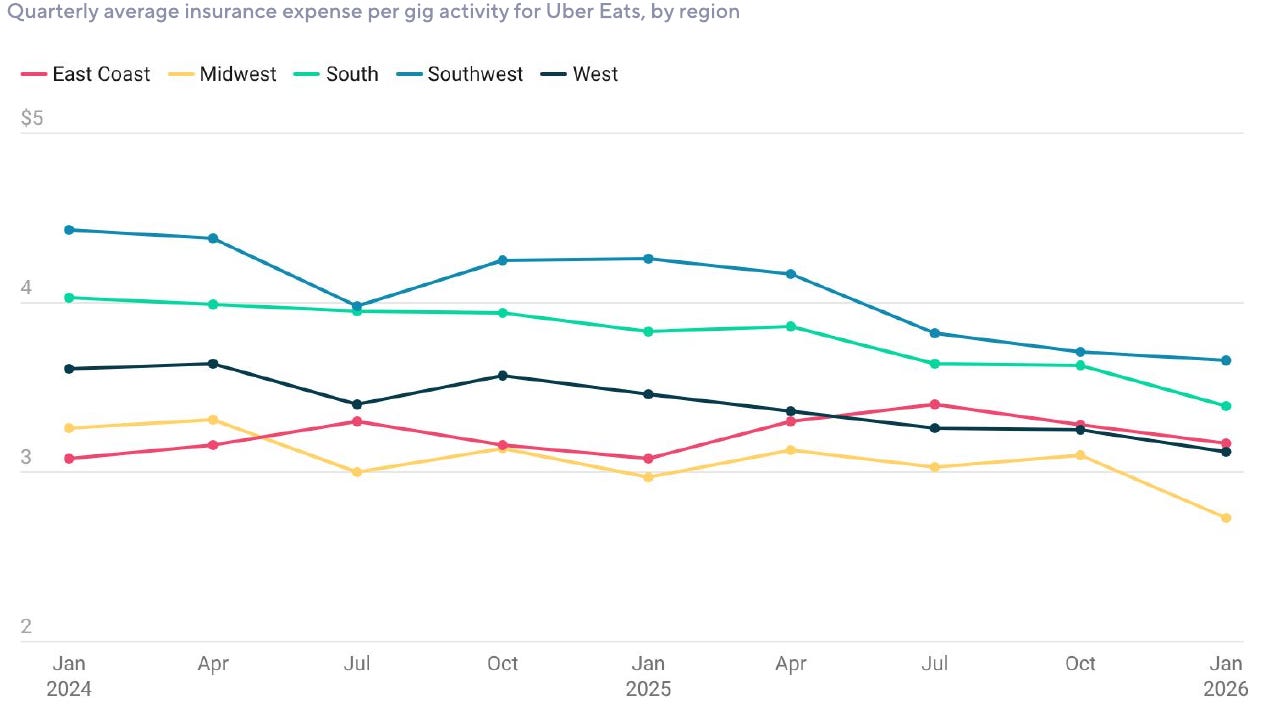
But delivery isn’t simply ridehail without the awkward small talk; its insurance geography is almost inverted. The West is still the most expensive region for rideshare coverage, while it sits in the middle of the pack for delivery insurance. Meanwhile, the Southwest and South see the highest delivery expenses for deliveries, but not for ridehailing.
Most regions also enjoyed meaningful delivery-insurance relief over the past year. Expenses fell 14.1% in the Southwest, 11.5% in the South, 9.9% in the West and 8% in the Midwest. The East Coast was the exception to the rule, with costs rising 3%.
That split matters for anyone trying to understand courier take-home pay. A modest insurance charge can still consume a meaningful piece of a relatively low-value delivery order, but we lack the data to see exactly how an average delivery order breaks down costs-wise. So while we can see that insurance expenses are shrinking; we can’t yet say how much of that relief reached couriers rather than platforms, merchants or customers.
West Coast, Best Cost Improvement
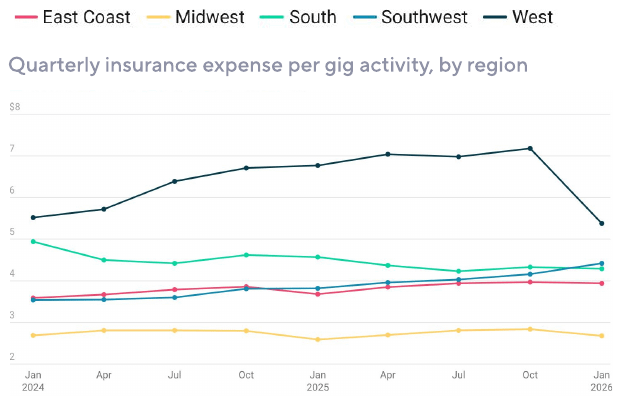
The most dramatic shift came out west, where rideshare insurance expenses plunged 20.6% year over year. There’s a fairly obvious suspect: California’s SB 371, which took effect January 1. The law reduced mandatory uninsured and underinsured motorist coverage from $1 million to $60,000 per person and $300,000 per incident, while leaving liability insurance minimums at the $1M threshold.
That’s a significant haircut, and the timing lines up neatly with the sharp drop between Q4 ‘25 and Q1 ‘26. While the data isn’t granular enough to see things on a state-by-state basis, California makes up such a large part of the “west” market that it would be hard to find another likely culprit.
Elsewhere, the story runs in several directions at once: rideshare insurance expense fell 6.3% in the South, but rose 15.8% in the Southwest, 7% on the East Coast and 3.5% in the Midwest. Insurance may be priced as one line on an app-generated receipt, but underneath it sits a very local mix of regulation, claims, trip types, driver pools and carrier appetite.
Those differences can even show up within a single city, not just across broad regions. In Chicago’s 20 lowest-income ZIP codes, insurance expense per gig was 37.6% higher than across the rest of the metro area, despite relatively similar trip distances. Insurance also consumed 18.3% of the customer price in those neighborhoods, compared with 12.5% elsewhere: suggesting that geography and neighborhood-level risk pricing can matter as much as mileage.
Pass the Savings (To Whom, Exactly?)
Here’s where the rubber meets the income statement. California’s law says savings from lower insurance expenditures should be passed on to workers and consumers: “it is the intent of the Legislature that this act ensures that financial savings realized as a result of any reductions in insurance expenditures for transportation network companies will be strategically reinvested to enhance the economic stability and welfare of drivers and riders.”
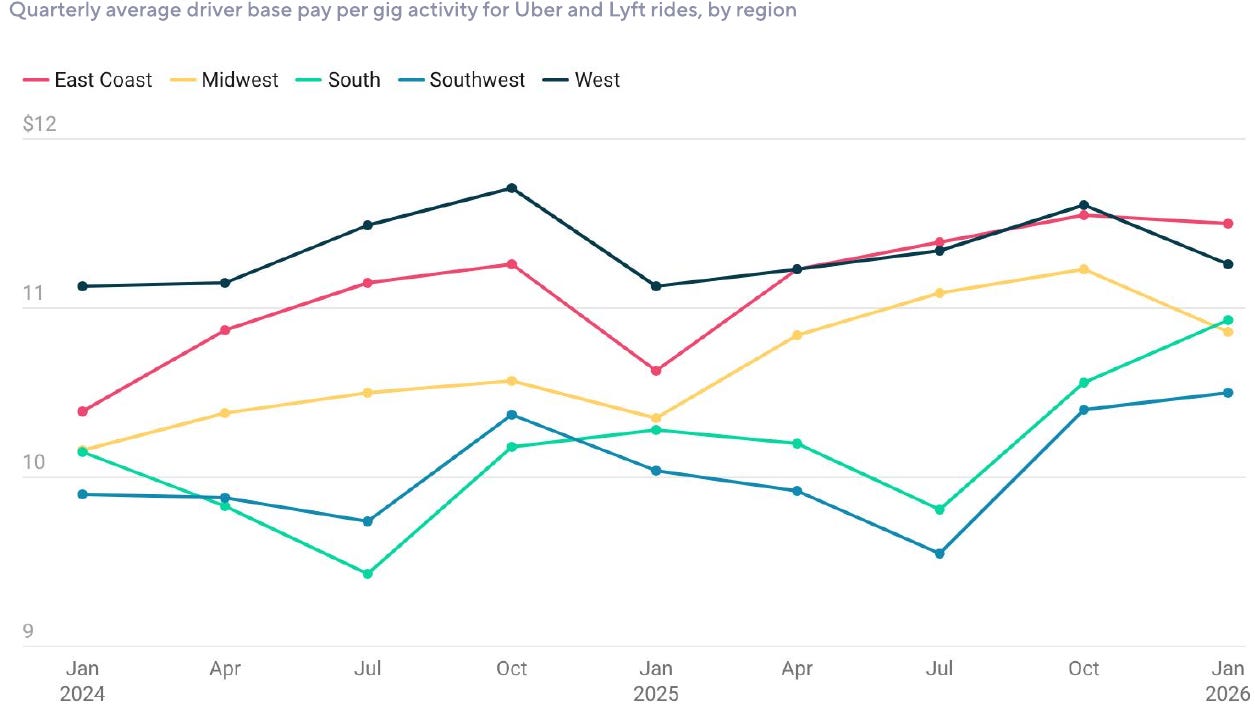
But so far, the early results don’t exactly scream “trickle-down.” While western insurance expense fell 20.6%, customer prices rose 3.4% and platform fees jumped 29.1%. Driver base pay increased just 1.2% — the smallest gain of any region. Some of the savings may have supported promotions, risk reserves, other operating costs or selective price cuts that disappear inside a regional average. Uber has also said it expects hundreds of millions of dollars in U.S. Mobility insurance-line savings in 2026 and that some will be recycled into lower ride pricing. But based on this initial snapshot, drivers have not been the obvious first stop for the windfall.
One caveat: Gridwise is analyzing the insurance expenses labeled by platforms within gig-level transaction economics. That is a valuable view of how a fare is carved up, but it isn’t the same as an audited, trip-by-trip account of what an insurer ultimately paid or what risk truly costs. Still, when a charge consumes one-fifth of the rider’s fare, and can move by double digits after a policy change, it deserves a bit of scrutiny.
The larger takeaway is that insurance isn’t a rounding error in the ever-growing industry of gig mobility; it’s one of the sector’s biggest economic levers. Ridehail carries the heavier burden, delivery follows a different regional logic and regulatory changes can bring costs down quickly. The remaining question is the one drivers and riders will care about most: when that lever shifts, who gets lifted?
HOT INDUSTRY NEWS & GOSSIP
Deliverance: Delivery and foodhall heavyweight Wonder just raised a fresh $650M in funding, with investors drawn to its vision of drone-powered deliveries saturating the fast growing suburbs of Texas. Over at Ottomate, I chatted with PJ Poykayil, Wonder’s Head of Customer Delivery Operations, about what it’ll take to actually make those logistics work at scale. And for folks out there wondering how Marc Lore keeps raising these big bucks, the $9B pre-money round offers investors serious down-side protection in the planned IPO.
Tesla troubles: Tesla released its Q2 earnings, with revenue coming in at a record $28.24 billion, but profitability falling wildly as the company ramps up spending. And while the company is launching new robotaxi markets — hello Orlando and Tampa — paid mileage growth seems to have flatlined. Meanwhile, the NHTSA is looking for internal corporate documents that may acknowledge that Tesla’s semi-autonomous systems would be safer with radar and rideshare drivers keep falling asleep at the wheel while using FSD.

Turkish two step: Elsewhere in AV land, Türkiye is emerging as a real hot-spot. Tripy is looking to deploy China’s Maxus Mifa 7 electric vehicle platform, equipped with CalmCar’s L4 autonomy, to the streets of Ankara. Meanwhile, Marti has partnered with Tensor (makers of sleek but very speculative AV hardware….) to launch robotaxis across the country.
Cams grilled: Camera-based road safety enforcement continues to take off across North America, with Toronto’s TTC turning on a Gatekeeper Systems deployment to protect streetcar riders. Meanwhile, Chicago’s system is hauling in better than projected revenue, with Amazon, FedEx and UPS appearing to be the worst infractors. But road surveillance systems of all kinds could be in political peril if Flock Safety can’t get its act together: its problematic software just resulted in police stopping another auto journalist, but the company insists its product is working exactly as it should, even as other Flock employees seem to be abusing its ability to spy on adults and children alike. Concurrently, the FHWA has removed speed cameras (and bike lanes) from its list of proven road safety measures.
Other cam stars: Former LA Mayor Eric Garcetti is joining Metropolis as an advisor, as the computer vision startup expands from parking into urban infrastructure, mobility, and other real-world systems. From what I’ve heard, expect to see some more interesting use cases pop up at airports!
Detour ahead: Despite its reputation for pro-transit urbanism, Europe continues to advance highway expansion projects that would be pretty much unthinkable in the more urbane parts of the United States. England’s National Highways just commissioned Europe’s largest-ever TBM to construct the Lower Thames Crossing, a new 2.6 mile, £11B ($14.7B) highway tunnel in the eastern exurbs of London. This joins projects like Berlin’s new in-city extension of the A100 that are arguably slightly more pleasantly designed than your average American freeway, but will still most certainly induce more driving.
Dead mall (sub)urbanism: The Dallas Mavericks just selected their developer, cementing plans to move the baseball team out of downtown and onto the site of the defunct Valley View Mall in North Dallas, building not just a new arena but a whole new entertainment district. Without even getting into the ridiculousness of the public financing of stadia (here’s a great blog if you’re into that sort of thing) the move will further drain the life out of Dallas’ central business district — one of the few walkable and transit-accessible parts of the region. While Dallas does seem to have some mild plans to improve sidewalks near the new stadium, the surrounding land use is inherently difficult to retrofit for urbanism. It’s ironic, but perhaps not unexpected, to see this sort of stadium-centered new urbanism move from being a tool meant to reinvigorate downtowns (see Columbus’ Arena District for a city-led model, LA Live for a sports team-led model, or even the development of the Mavs’ current home) to another tool for pushing out auto-oriented sprawl (also well exemplified by the Braves’ recent move to “The Battery.”)

Le covoiturage convergence: France’s Karos just finished consolidation of the country’s daily carpooling services, buying up the division of BlaBlarCar that’s focused on short-distance commutes. BlaBlaCar will focus its coverage on long-distance carpooling, making it a one-stop shop for travelers looking to criss-cross countries by bus, train or shared car.
Join my team! Calling all self-starters: MobilityVC seeks a Ventures & Advisory Associate.
A few good links: Milwaukee transit flirts with death spiral as 25% service cuts loom. Talk about power hungry — Valar Atomics eyes $1B round. FRA study identifies Penn Station capacity upgrades, includes limited through-running. Interview with Uber Chief Product Officer Sachin Kansal. Hyundai buys remainder of Boston Dynamics from Softbank. Bingo E2 launch party set for 7/28 in Nairobi. Tyred raises £2.5M for ebike subscriptions and mobile repairs in UK. Ship crews offered huge bonuses to transit Hormuz as attacks flare. Saddled by low salaries and high costs, Miami is now the country’s second least affordable metro area. DC fast charger availability improves. NYC cabs now available on Curb and Lyft; Curb Flow goes live in North Carolina. Atlanta considers dynamic curb management. You love to see it: NYC Mayor Mamdani promises small-business regulatory and permit reform. Archer and Anduril partner on military eVTOL. Amazon Now adds fresh offerings in Brazil. More evidence that even high-end housing construction helps renters across all income levels. Aurora debuts second-gen driverless truck. Avride delivery bots stuck in the rain as Jersey City hit by deluge. Wheely fights NYC rule requiring detailed customer trip pattern disclosures. Veo goes live in Salt Lake City. Voi quarterly revenue climbs 47% YoY to €68.8M.
See you next week!
- Jonah Bliss & The Curbivore Crew