

Across the globe, gas prices continue to climb inexorably higher. AAA says a gallon of regular gas is currently $4.555 on average, climbing five cents from last week, up over 50 cents from a month prior, and almost 50% higher than what folks were paying at the pump a year ago.
We’ve already tracked what a big impact these rising costs are having on everyday commuters, long-haul truckers and even transport operators. And recent Q1 earnings reports showed that ridehail and delivery companies alike are starting to see a mild impact on their margins, as they pay out tens of millions of dollars in gas rebates. But what about gig workers? Our partners at Gridwise Analytics have a new report — How Rising Fuel Prices are Impacting the Gig Mobility Industry — showing just how much these surging costs are weighing on everyday delivery and ridehail workers.

As of last month, 17.4% of ridehail workers’ pay is going straight to their gas budgets, up from 13.2% at the start of the quarter. For delivery workers, who generally travel shorter distances, that number has spiked to 15.6%. (Note: this doesn’t factor in maintenance, depreciation or any other related expenses.)
Rising expenses would be manageable if fares were climbing, but so far the apps have been shielding consumers from most inflationary pressure. Ridehail pay has ticked up to $24.07 per hour, but remains below the highs seen in 2021-2023. Delivery pay, sitting at $15.22 per hour, is up 10% from last summer, but also remains below earlier highs.

While the platforms are offering some relief to workers in the form of higher gas rebates, uptake so far seems limited: Gridwise found that only 17.4% of Uber Eats workers had used the program in its first week, while DoorDash’s $5 to $15 incentive system had reached around 40% of workers. Lyft, meanwhile, has offered some relief to workers by cutting its median platform fees by 13%.
All in all, the average ridehail worker driving 500 miles per week faces roughly $24 in additional weekly gas costs, taking a substantial bite out of their earnings: last year the average weekly gross earnings for a driver was $522 at Uber and $325 at Lyft. Add that up and some drivers are taking home 7% less thanks to higher gas prices. As the war drags on, expect to see more structural shifts: workers dropping out of this particular labor pool, deliveries shifted to bikes or bots, and consumers eventually footing more of the bill. Get more insights in the full report, published by our partners at Gridwise Analytics.
ZAG TALK PODCAST
In the latest edition of the Zag Talk podcast, Jonah Bliss sits down with our partners at the McKinsey Center for Future Mobility, discussing their new report that contends that the coming AV revolution will not only upend car ownership, but have a deflationary effect on overall transportation spending. Jonah, Ani Kelkar and Darius Scurtu dive into the second-order effects as well, like what that could mean for congestion and land use, as well. Listen in!
HOT INDUSTRY NEWS & GOSSIP
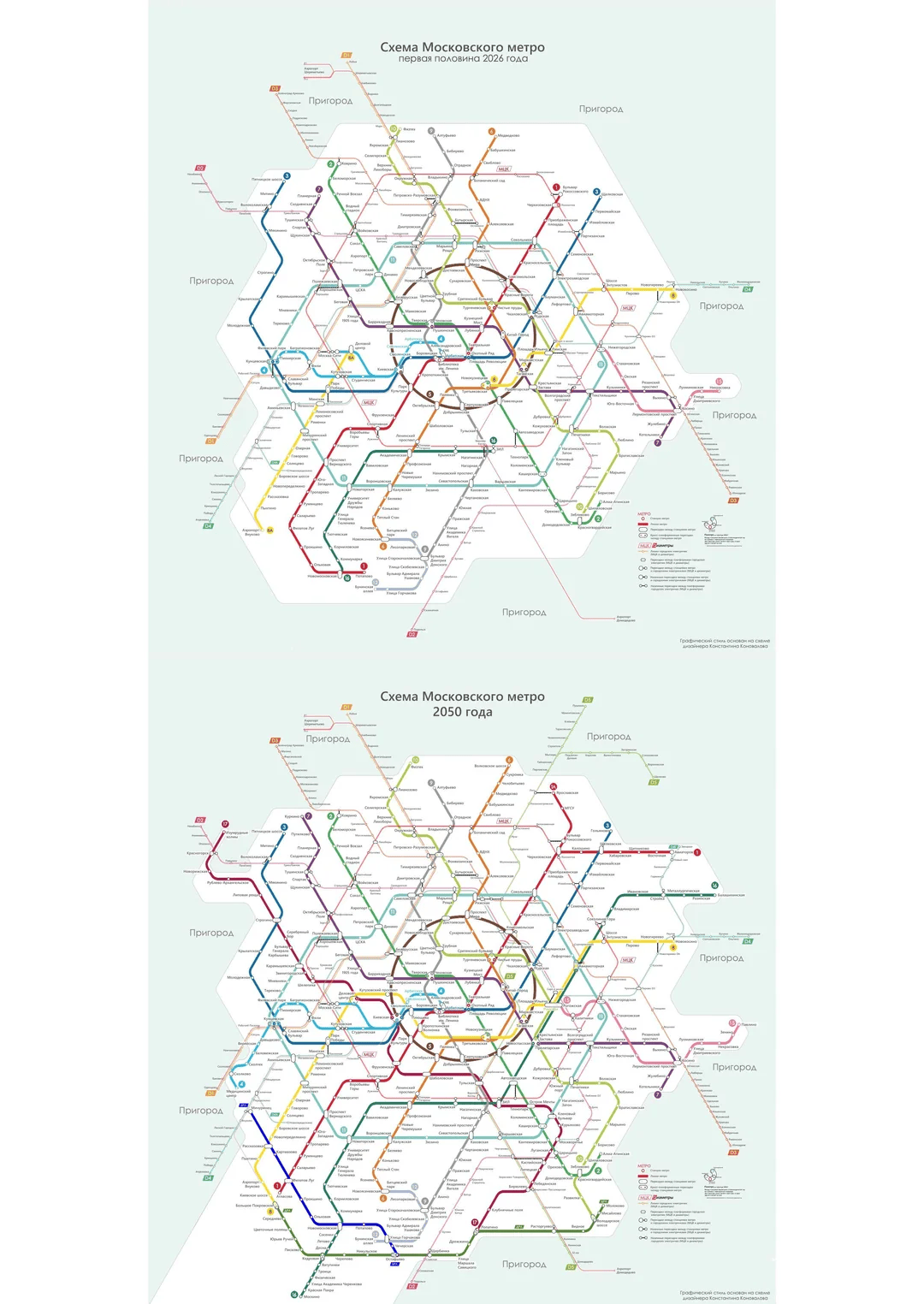
Transit expansions across the globe: Sydney looks to expand light rail to its east side, in a $3B bid to improve access to new homes. Malaysia approves $2.5B elevated rail system for Johor Bahru. Turku, Finland okays first tramway. Saudi Arabia seeks bidders for $16.5B transport system in Mecca. And check out how much Moscow’s transit system will expand by 2050 (or should that money be spent on war reparations?)
KC, mo’ rail… Kansas City just inaugurated an expansion of its streetcar, extending it 0.7 miles to the riverfront. Most Ray LaHood-era streetcars have been boondoggles, but this one gets decent ridership. On a less decent front, the local public transport authority is looking to cut 1/4 of its bus routes due to a funding shortfall.
Carbnb: Airbnb is muscling its way into the car rental business, as part of a larger push into ancillary services that also includes grocery delivery and airport pickups. Those latter two are in partnership with Instacart and Welcome Pickups, so I’m surprised they decided to step on Turo’s toes, instead of collaborating on that product as well.

We’re all delivery businesses now… Walmart released its Q1 earnings, showing revenue up 7.3% and profit hitting $5.33 billion. But more interesting were the levers of that growth: global eCommerce sales grew 26%, membership fee revenue grew 17.4%, ads were up 37% and store-fulfilled delivery jumped 45%.
Happy 250th, Uncle Sam! The House released the BUILD America 250 Act, the latest version of the IIJA, allocating $674 billion in core reauthorization, with $240B in authorized and direct funding for transportation services and infrastructure. $110B goes to roads / bridges, $102B goes to railroads (in what would be Amtrak’s largest investment ever,) $25B to aviation and $17B to ports.
“One entered the city like a god. One scuttles in now like a rat.” The Feds have released plans for the reconstruction of Penn Station. The $8B+ update keeps the basketball stadium above, while refreshing the exterior with a “classical look” 🙄 and raising some interior ceilings. More importantly, the plan allows for “at least limited” through-running of NJT and LIRR commuter trains, an important step towards creating a modern regional rail network.

State capacity rules everything around me, scream: Los Angeles is asking state officials for a six year extension on $100M in grant funding from 2022-23, lest the city be forced to return the funds. These would fund a number of street, sidewalk and bike lane improvements across the city, but the municipality lacks the staffing to get the projects done in time.
Ad astra, you assholes! With SpaceX’s monstrous IPO looming, aerospace investments couldn’t be hotter. More interesting is this new research paper, looking at how the commercialization of space in the 1990s changed the economic rationale for different space-based products and services (cube-sats, satellite internet, etc) but did not change the industry centers most tied to the aerospace economy. (California, Texas, Ohio, DMV, Alabama.)

Charged up for good: Our friends at Women Who Charge are looking for industry professionals to "lean in" and support the next generation of clean transit and energy leaders. If you’re based in Colorado, please take a look at this 501c3.
A few good links: Congrats to our friends at Bingo on unveiling their new micro EV purpose-built for ridehail drivers in developing economies. LIRR strike ends after compromise on pay raises. Join our pals at It’s Electric and Slate for a product preview in Koreatown, this Sat. There’s always money for war: Anduril raises $5 billion at a $61B val, with an emphasis on new manufacturing capacity. Buffalo, NY launches smart curb pilot. Venture funding is concentrating into $500M+ mega-deals. Siemens Mobility buys MERMEC. OEMs look to new verticals as car profits shrink. Archer and Joby duke it out in the skies with competing lawsuits. Fragile raises nearly $100M for hardware subscriptions (MobilityVC has had the pleasure to work with this ace team as they scale up an amazing business.) Nefarious Midwestern realtors try to block open access to listings. India’s Scapia raises $63M for travel booking and mobile payments. Whizz and DoorDash scale up subsidized e-bikes for couriers. Stellantis chooses Wayve for AV integrations. InDrive and GoCab partner to add supply in Chile and Morocco. Flytrex opens drone manufacturing facility near Dallas. Chicago’s infamous privatized parking meters are up for sale again.
Don’t forget to join us in Detroit on June 9th for our next Urban Autonomy Summit.
- Jonah Bliss & The Curbivore Crew