

A new national survey, commissioned by Flex Association and conducted by Morning Consult, first shared exclusively with The Curbivore, shows that app-based platforms are no longer a niche. These platforms — think Uber, DoorDash, Instacart, Lyft, Grubhub, HopSkipDrive and Shipt — are now used by the vast majority of Americans, from coast to coast.
From ridehailing, to food and prescription delivery, app-based platforms are now an everyday part of American life. Seventy-two percent of U.S. adults have used an app-based platform as a customer. More than half used one during the past three months, nearly a quarter use platforms more than five times during a typical month, and two-thirds say the services are valuable to their daily lives (up from 63% in 2023.)

While usage may still be on the rise, adoption isn’t universal. Higher-income city dwellers are far more likely to turn to mobility and delivery apps than their poorer, rural counterparts. Sixty-four percent of those making $100k or more reported usage in the past three months, as compared to just 46% for those making under $50k. And there’s very much a lingering digital divide between the old and young: while 57% of those aged 33-45 used the apps in the past quarter, only 44% of those 65 and up did so as well.

These differences become even more pronounced for super-users, the folks using app-based platforms more than five times per month. While 23% of Americans are using these services on a weekly basis, those aged 18 to 34 are three times as likely to do so as those aged 65 and up. With the federal government drastically cutting back on SNAP benefits, which up until recently had been a growing market for grocery delivery platforms, don’t be surprised if lower-income usage falls further in the years to come.
From Side Hustle to Recurring Income
While consumer adoption is slowing, the gig workforce continues to accelerate. The share of adults who have ever earned through a platform increased from 36% in 2023 to 43% today, while the currently active share rose from 23% to 28%.

For most, this is still very much “gig” work, as over two-thirds put in 15 hours or fewer per week on the platforms, and 63% also hold a traditional W-2 job. But 22% of platform workers get the majority of their income from these apps: that’s many millions of Americans.
The Haves, the Have-Nots and the Multi-Appers
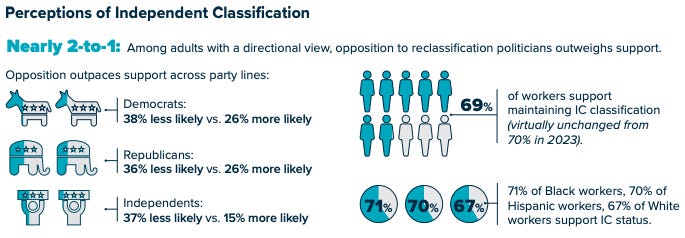
In a country growing ever more polarized, support for gig work was surprisingly consistent across political lines: Democrats and Republicans alike both supported and opposed worker reclassification at near-identical rates.
Where we do see a big difference is in which states see the most app-based platform workers. Uptake is highest in the South, alongside states like California and New York. In general, these are the states with the lowest average incomes, or highest costs of living, suggesting more workers are turning to apps to make ends meet.

Interestingly, as these platforms become a part of everyday life, the income appears to be becoming less of an emergency lifeline and more of a routine supplement. In 2023, 54% of app-based platform workers reported the income was ”very helpful” for dealing with inflation; by 2026 that number fell to just 42%. And while workers are relying on these apps to make ends meet, they aren’t loyal to any one platform: 77% reported they multi-app, meaning they turn to a mix of platforms for work.

It’s an app-based world, and we’re all just living (and working) in it.
HOT INDUSTRY NEWS & GOSSIP
The honeymoon is over… Uber and Waymo’s partnership seemed contentious from the start: were they partners or competitors? The wheels started to fall off a few weeks back, when Uber’s CTO started tweeting about “scary” Waymo moments, followed by the two sides taking jabs about whose service better emphasized “equity.” Now it’s officially over, in Phoenix at least: less than three years after putting Waymo rides in the Uber app, Dara & Co no longer list the Arizona capital as an autonomous market. Uber appears to be readying a new partner for the region, while Waymo says it has reintegrated the “pilot” vehicles into its fleet.
Lime green: Micromobility stalwart Lime finally went public, raising $167M in the process. As previously discussed, most the funds will go towards paying down debts. The company is aaaalmost profitable, and saw a nice 9% jump on opening day, valuing the group at around $1.66B. It fell a tad today, sitting at a cool $25 per share.
More money: Meanwhile, Bolt has claimed its first annual net profit, claiming €920,000 ($1.05M) in net income on €2.27B (up 14% YoY) in revenue. The private Estonian company offers a mix of ridehailing, food delivery, carsharing, and micromobility services across Europe, LatAm, Africa, and Southeast Asia. And in China, AV player Momenta readied for a Hong Kong IPO, seeking to raise up to HK$5.89 billion ($751M).
Feeling bloated? The ever increasing size of cars isn’t just an issue for pedestrian safety, it’s also a simple geometry problem. When each car is a bit bigger, your average city block can fit fewer of them for parking or driving. New research shows that cars have been growing an average of 1.2 centimeters (half an inch) per year, resulting in about 100,000 fewer parking spaces in cities like London and Berlin by 2040. Given how much every driver loves an easy parking spot, most car buyers are perversely making their own problems worse. Another new piece of research draws a similar conclusion, finding that the proliferation of autonomous vehicles is eating into usable curb space. As usual, the easiest solution would be charge the market clearing price for these negative externalities…

Adjö and 再见: And just like that, the American car market got a bit more insular… the U.S. Department of Commerce’s Bureau of Industry and Security has denied Polestar the right to sell new vehicles, starting with model year 2027. The administration decided the Geely-owned automaker had run afoul of the Connected-Car Rule, but in typical opaque fashion has not clarified why their other subsidiaries — Volvo and Zeekr (maker of Waymo’s new Ojai) are still cleared for business.
Ride on… The Outdoorsy Group has officially rebranded as The Ride Platform. While the company got its start as a P2P marketplace for RVs, it’s since expanded into a car rental marketplace (Ride), a fleet management stack (Wheelbase), and an AV insurer (Roamly FSD). Along the way, the company just celebrated hitting $4 billion in GTV.
The geography of jobs: The BLS just released its latest payroll data, showing that 38 of America’s 50 largest metro areas have now recovered from Covid-era job losses. The fastest growing regions have been Austin (up 23.8%), Raleigh, Dallas, Nashville and Salt Lake City, while places like SF, Milwaukee, Portland, Boston and Cleveland still haven’t regained all the jobs they lost. Combine that with the fact that office construction has hit its lowest levels since 2011, and I’d say that we’re unlikely to see much new growth in public transit ridership nationwide…

It’s cool to pool! French carpooling platform BlaBlaCar is on an expansion spree, as it doubles its geographic footprint to serve 41 countries. The company plans to up its service in Europe, LatAm and Southeast Asia, while launching its initial foray into Africa. BlaBlaCar execs credit AI for letting them expand faster, speeding up software and language localization build outs. Last year, the company served 40,000 commuters per day in France and grew 47% in India to 19M passengers.
Pod shop: Aseon Labs just raised $10M, in a seed round led by Crane Venture Partners and with participation by Y Combinator and mobility heavyhitters from the likes of Uber, Turo, Nuro and Zimride. The company hopes to build and deploy robotic pods that can be placed in underutilized urban parking spots, letting AV fleets perform charging and cleaning in a more decentralized fashion. Personally, I think it would be a bit simpler to pay the clerk at the convenience store to plug in the charger and brush off the crumbs, but you gotta say the word ROBOTS!!!! to raise money these days.
The beautiful game? Streetlight has taken a look at congestion data around America’s World Cup stadia, finding that travel times crept up 7X near New York / New Jersey’s Met Life Stadium, while travelers near LA / Inglewood’s SoFi Stadium took over an hour to go five miles. Meanwhile, the APTA has the latest roundup on how transit agencies are using the games to boost ridership. It does look like there are some nice tourism spillover effects happening: the Kansas City streetcar logged record ridership (39k trips in one day), despite being nowhere near the stadium.

A few good links: Enjoy the darkness — LA property owners reject confusing street light measure. Chicago’s infamously privatized parking meters sold to new ownership group. Slowly rebounding transit ridership in SF looks to be lower-income than in the pre-Covid days. Beat the heat: different metro cars in China are set to different temperatures, so you can pick the carriage you find comfiest. CaoCao and May Mobility partner to bring robotaxis to Europe, while Waymo registers its first German entity. CA lawmakers sign deal to increase ridehail safety measures, reduce medical liens, looking to avert dueling ballot measures. Car subscription platform Autonomy nabs new CEO, while Germany’s Finn hits unicorn status. Not so green: LA’s massive warehouse fire likely caused by unpermitted solar array. Acodyne raises €2.5M for autonomous cargo drones. LA upzones transit adjacent parcels, but leaves single family homes untouched (this is why state bills like SB79 are so important!) Santa Barbara votes to keep its main shopping street closed to cars. UAE launches first regional train service (powered by diesel, of course!) Russia closes border rail crossings with Finland, Estonia, Latvia. Joby and Toyota launch air taxi manufacturing JV. CMA CGM buys FedEx Supply Chain unit. New Taipei inaugurates 9 mile MRT Sanying Line. Wonder and Zipline partner on Dallas-area drones. Nexar merges with Nauto. Uber reorganizes data labeling biz. Who owns the sidewalk? Issues with IFP’s transit abundance project. Miami-Dade nears deal for commuter line on Brightline tracks. LA adds new peak-hour bus lanes. MA proposes requirement that ridehail fleet renters only offer EVs. When the going gets tough… Bosch CEO steps down. North Carolina legislature approves bill to eliminate parking minimums statewide. NHTSA readies new standards for robotaxis, eliminating vestigial human driving components. Charging accessibility overtakes costs as biggest barrier to EV adoption for ridehail drivers. State of California pushes four days per week RTO. New Gridwise data shows delivery and ridehailing insurance costs falling, with significant regional variation.
And lastly, thank you to London and New York for coming out to celebrate the mobility community!
- Jonah Bliss & The Curbivore Crew