

Dispersed or condensed? Polycentric or hyper-centralized? Hong Kong or Tokyo? When it comes to any topic related to urbanism, mobility or delivery, the spatial distribution is always an open question. Autonomous vehicles are no different, with questions about where to site maintenance and staging hubs currently being debated in cities and board rooms across the globe.
While high land prices and concerns around deadheading mean they won’t all be located in the center city, there’s still plenty of debate around how many hubs each subregion should get, and how big (and thus, disruptive) each hub should be.
On this week’s episode of The Courier, I sat down with George Kalligeros, Co-Founder of Aseon Labs. Aseon’s building eye-catching, automated “pitstops” for robotaxis, with the idea that you can scatter these self-contained maintenance hubs all over a city. So if a Waymo needs a quick top-up of energy, or a light cleaning between riders, it doesn’t need to dawdle all the way back to a big centralized hub (where neighbors may be up in arms over noise and light). Instead, these pods can be located on under-used real estate: a parking lot, a gas station, a car wash, etc.
Per George’s telling: everyone wins in this scenario. And with a résumé that spans Mercedes, Bentley, Tesla and TIER, he makes a pretty compelling case! Listen in for the full, nuanced discussion, as well as the latest takes from Greg and myself on Grubhub, Walmart, Jensen-gate and more. (And if you’re lucky enough to be reading this on Thanksgiving, treat yourself to 2-for-1 tickets to Curbivore!)
Partner | See Trends Others Can’t

Amazon Prime swapped Grubhub for Uber Eats as its food delivery perk. You can determine the risk to DASH by understanding:
What % of Amazon users are currently using DoorDash?
What % of DoorDash’s userbase are likely Prime members?
For both of these cohorts, are they heavy or light users of DoorDash?
These are questions only Apptopia data can answer, our competitors cannot.
HOT INDUSTRY NEWS & GOSSIP
A real head scratcher! After earlier reporting revealed that Wonder was looking to offload its Grubhub subsidiary — see our earlier writeup on Modern Delivery — the company now says it’s no longer pursuing a sale. Some juicy numbers have also leaked out: Grubhub will lose about $97M this year, which sounds pretty tame given Wonder’s growth ambitions; the 3PD will also do ~$6.4 billion in GTV, a good order of magnitude smaller than either DoorDash or Uber Eats’ U.S. gross transaction volumes.
You know I love carsharing: New data from INVERS shows that Europe loves it too: station-based, free-floating and peer-to-peer systems have grown 23% in the past two years. Germany has the most shared cars overall, while Baltic countries have the most per capita.

Speaking of shared mobility… Barcelona-based Cooltra acquired France’s Motto, creating a European shared two-wheeler juggernaut. The combined company will have about 30,000 mopeds and 6,000 e-bikes in its fleet, available for monthly subscriptions / leases, as well as shorter-term rentals. In the U.S. and Australia, our fund’s backed Wombi / Lug & Carrie.
Sorry, climate! The United Nations’ COP31 climate talks, hosted in Turkey, broke down, leaving the world ever further from cutting emissions. Sticking points arose over carbon removal, Europe’s worries over fuel security and America’s absence from the talks. Stateside, the Senate passed BAAJA, a wide-ranging permitting reform bill. Some think it’ll hasten our ability to bring green energy systems online, others worry it’ll simply fast-track more carbon emissions; either way it faces an uncertain outcome in the House.
Nuber? Luber? Luro? Nucid? I’m afraid there’s no elegant portmanteau for Nuro, Uber and Lucid’s combined robotaxi efforts. But whatever you call it, the consortium has begun driverless testing on public roads in the S.F. Bay Area. We’ll have plenty to discuss at Jan. 27th’s Urban Autonomy Summit — San Francisco edition!

Can we please call it decongestion pricing? There’s now even more research showing how successful NYC’s rollout of a congestion pricing cordon has been, with travel times improving, public transit receiving new funds and local businesses suffering few adverse effects. The program has been such a success that the USDOT, which previously sued to stop implementation, has announced $100M in new grants for other cities to pursue similar setups, although with some funny back-and-forth on what they want the program called. (See my earlier write-up on the subject.)

State capacity rules everything around me, S.C.R.E.A.M.: New research on plan checkers (the gov’t workers that review development plans) shows that a one standard deviation faster worker issues permits 46 days quicker, with NO adverse effects on construction quality. Every extra $1 spent on staffing returns $2.16-9.02 in benefits to builders (maybe fees should be higher then.) And speaking of declining public services, Floridians are quickly realizing that now that they’ve slashed their property taxes, their local governments won’t be able to pay for things like bus services (but maybe that was the point of Amendment 3 all along?)
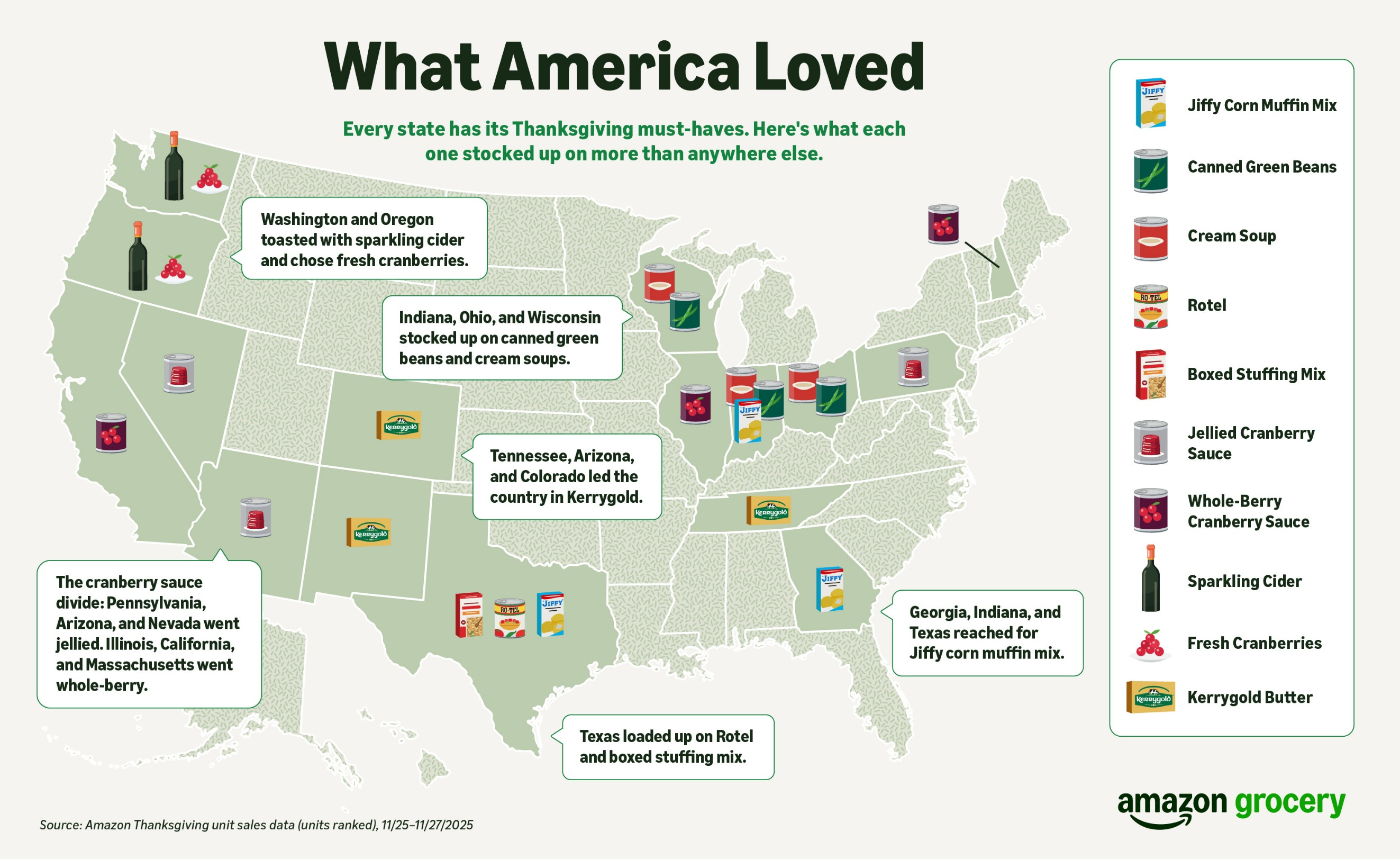
Modern Delivery, quick hits: Amazon Prime Air drone hits utility wire, crashes in garage, in Michigan. And just in time for Thanksgiving, Amazon has mapped America’s top holiday grocery must-haves; number one nationwide is “heavy whipping cream” (yum!)
Speaking of Thanksgiving… score Black Friday savings on Curbivore 2027! Now’s your last chance to score 2-for-1 tickets to our greatest gathering yet: that works out to just $149.99 per person!
So much for being the “business mayor!” SF’s Lurie does an about-face on park parking, cuts planned fees, leaving $8M budget gap for parks department.
The beatings will continue until morale improves: Our dear President heard midterm voters’ concerns about affordability loud and clear. That’s why he’s just launched yet another round of illegal tariffs; take that, Switzerland!

A few good links: Population loss is a hell of a drug… Japan mulls converting rural rail lines to busses. Now hiring: incoming LA mayor Nithya Raman seeks kick-ass public servants. Electric truck sales are booming in China, boosting demand for lithium. Every Trader Joe’s in LA, ranked (I’m partial to the two Sherman Oaks locations directly across the street from one another.) Mercedes launches new hands-free driving system in select markets. Aerospace and defense funding overtakes traditional tech in SoCal. NYC proposes maintenance fee for curbside trash bins. For the first time in decades, a GM EV1 is back on the road (too bad this article reeks of AI writing.) Embo raises $110M seed for robotic AI models. Simplexity raises $100M for humanoids. Amtrak sees record ridership amid high gas prices, improved service. America faces a school bus driver shortage. Power broker: Gov. Hochul pushes TWU President John Samuelsen off MTA boad after surfacing that he doesn’t actually live in New York. Sign of the times: Culver City approves parking maximums. LA County housing production perks up. Why NYCMTA’s bus predictions suck. Spain’s Basque Region inaugurates new S-Bahn-type rail service (see map.) Lyft plans to launch signature ridehailing service in Europe, eventually retiring FreeNow brand. NYC and Lyft agree to lower Citi Bike rates, but service expansion looks unlikely. APTA sees U.S. public transit ridership climb 2.8% in Q3, driven by big city rail systems. Will congress restore battery funding?
Happy Thanksgiving!
- Jonah Bliss & The Curbivore Crew