


America’s mid-term election may have been over a week ago, but the results are still trickling in. While most House and Senate candidates didn’t put transportation at the front of their agenda, the incoming Democratic majority is sure to prioritize a far more balanced approach than the outgoing congress. At the state and regional levels, transit was front and center in a number of campaigns. And when given the option, voters by and large voted for more transportation, and they were more than willing to pay for it.
Washington: New Majorities, Familiar Problems
Starting at the federal level, Democrats taking the House and Senate portends better days for public transit. With the IIJA surface transportation authorization extended through December 11th, it looks quite possible that negotiations about its replacement bill — the BUILD America 250 Act — will push into the new term. The current version sees public transit spending projected to dip; incoming Democratic majorities should press for stronger funding.
Reauthorization also requires confronting the Highway Trust Fund’s structural deficit, with CBO projecting exhaustion in 2028. BUILD proposes federal registration fees on EVs and plug-in hybrids, but that wouldn’t close the gap. With gas prices still elevated, I don’t think we’ll see Dems, elected on the back of affordability concerns, pushing to raise the gas tax. A sensible compromise would be to directly tax domestic oil producers, since the cost of production hasn’t gone up alongside higher pump prices. But odds are we’ll just see more general-fund transfers.
Dems also have an immediate fight over money Congress has already provided. FTA and OMB have stalled the Capital Investment Grants pipeline: in August, congressional Democrats identified more than $1.9 billion in unobligated, unallocated funding while accusing the administration of holding up qualified projects, including LA’s Southeast Gateway Line and Boston’s Green Line Transformation, for political reasons. Expect Democrats to use their congressional committees to scrutinize these delays and push to get the funds flowing once more.
Those aforementioned affordability concerns could also mean the return of purchase subsidies for electric vehicles. EV sales have languished since the old credit expired in 2025. While any new act would require the President’s signature, “cheaper cars” feels like an uncontentious enough idea that it could engender a brief flash of bipartisanship.
I think that comity is less likely to extend to autonomous vehicles. The SELF DRIVE Act has been kicking around for some time now; while it does have some support from Democrats in auto-making regions, its principal sponsor is Ohio Republican Bob Latta. Given the populist fracas about all things “AI,” I’d say odds are slim that the new congress looks to fully preempt the states and cities that are looking to have a say in how autonomous vehicles get deployed.
States’ Rights (to Have Good Transit)
Moving down to the state level, gains in Pennsylvania and Texas are particularly meaningful. In the Keystone State, Democrats have taken a trifecta, with Governor Shapiro making transportation improvements a key priority. The outgoing Republican Senate majority blocked funding for Philly and Pittsburgh’s transit agencies, forcing the two to teeter along on emergency funding fixes and diminished service. Shapiro’s existing 2026–27 budget proposal would dedicate an additional 1.75% of statewide sales-tax collections to the Public Transportation Trust Fund beginning in July 2027. Other legislation in the works, like HB 1146, would allow for local regions to further enhance transit budgets with local taxes and vehicle fees.
In Texas, the situation is a bit less cut and dry; Democrats took the governorship and House, but not the state Senate. In the medium-term, Governor Elect Hinojosa and the Republicans may work out some funding packages with a bit more transport funding, but she’ll also have the opportunity to reshape the Texas Transportation Commission, which governs TxDOT and statewide transportation planning. Urban Texans will also see some real relief simply by having the state government spend less time actively antagonizing its cities: the previous administration went out of its way to stop Austin’s CapMetro from trying to build rail, while also making it easy for Dallas-area suburbs to pull out of DART.
Local Measures, for Good Measure
Of course, there was plenty to celebrate on the regional level as well: 22 of the 27 measures put before voters passed. The biggest money came out of the SF Bay Area, where the region as a whole approved new sales taxes for BART and Caltrain, while SF-proper okayed parcel taxes for Muni. Seattle also approved $1.38 billion in new sales tax revenue, collected over 10 years, with 100% directed to public transit. Voters in Colorado approved billions for regional rail, connecting Denver to Fort Collins, Colorado Springs and Pueblo. Even more suburban areas, like Riverside and San Bernardino counties, as well as small towns from Michigan to Kansas, voted for more transit operations and CapEx.
Congrats to Our Curb Candidates
I’d be remiss if I didn’t give a special call out to two candidates that have been particularly big advocates for improved transportation and urban land use. In San Francisco, Scott Wiener will take over Rep. Nancy Pelosi’s old seat, after a hard-fought battle against SF Supervisor Connie Chan. He joined us on The Courier podcast late last year, getting wonky about all the ways he has fought for streamlined housing production and more transit funding.

And here in Los Angeles, Councilmember Nithya Raman defeated incumbent Mayor Karen Bass, tapping voter discontentment over sclerotic public services in general, while also campaigning to increase housing production and speed up transit improvements. She shared her decidedly technocratic proposals at our last Curbivore gathering in April.
I dive even further into the election, as well as related news items like EV startups raising big rounds and Tesla killing off the Cybertruck, in this week’s episode of The Courier. Greg and I are also joined by Mark Goodstein, Co-Founder of Streetscope, to discuss his attempt to build a standardized benchmark for traffic safety. Listen in!
11/19 Happy Hour: Join Us in Downtown LA
Next week, the world of mobility converges in Downtown LA, thanks to our friends at CoMotion and AutoMobility. We’re caping off the festivities with an acclaimed happy hour mixer — Thursday, 11/19 from 5 to 7 in Little Tokyo — alongside our partners at the Michigan Department for Labor and Opportunity.
HOT INDUSTRY NEWS & GOSSIP
This cutie can haul! At long last, Toyota is bringing its famous kei mini-trucks to America, as part of the relaunch of its Scion brand. The KEI-01 is a rebadged Daihatsu Hijet, to be assembled in Indiana to American specifications. To first test the waters, the vehicle will only be available to fleet customers, and classified as an LSV: meaning no highway usage. It weighs about 1/4 as much as a Toyota Tundra.

Sky high ambitions: Wing and Walmart continue to expand their drone delivery partnership, with three new sites going live in the Memphis metro area. This launch is more interesting than the usual expansion across Dallas and Charlotte, as Memphis is a particularly low-income region. The 72301 zip code, containing West Memphis’ Walmart Supercenter #70, has a per capita income of just $21,362, with many residents living a long distance from grocers. Given that Wing charges zero delivery fees, this definitely helps some folks living in a food desert. On the other side of the world, Wing is partnering with KDDI to bring drones to Japan.
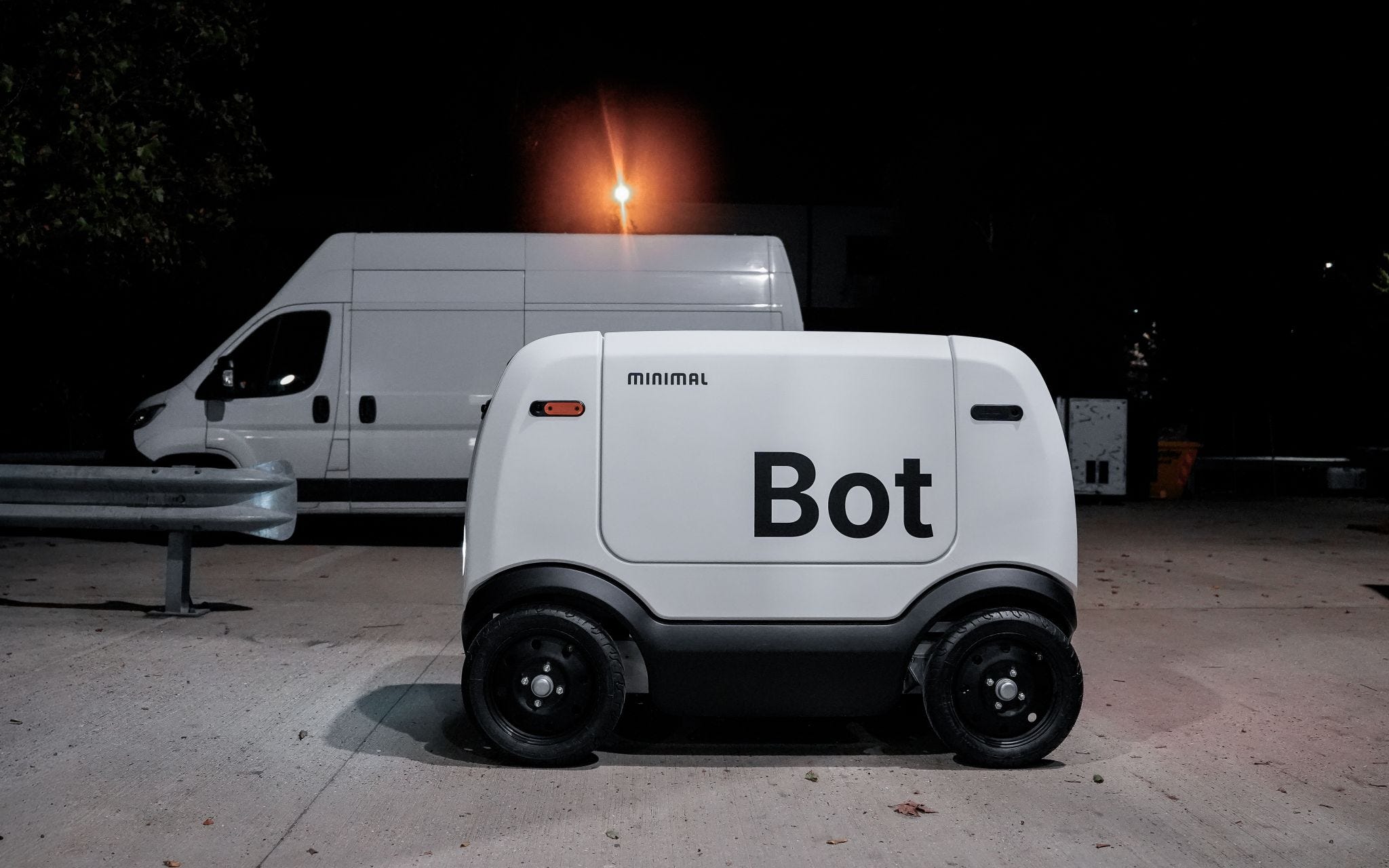
A new bot enters the arena: Minimal, the British manufacturer of an eye-catching e-quad, has a new delivery vehicle in its arsenal. Meet Bot, its succinctly named delivery robot, unveiled at Micromobility America. This new hardware is large enough to ride in the street, and should show up stateside in 2027.
Is this green news? SoCal based OEM Harbinger just raised a $240M Series D, co-led by Tiger Global, Capricorn and Ridgeline. This story really cuts across both sides of the aisle though, as the new funding will accelerate the electric vehicle manufacturer’s push into… (drum roll)… defense!
Oh, Elon: Meanwhile, Tesla is ending production of the Cybertruck in 2027, after delivering just ~70,000 vehicles sinc e2023. The company claims it will use the freed up production space to ramp up Cybercab production, but the company is already producing more of those than it can put into service, and the NHTSA is still investigating whether the vehicle should even be allowed on the streets. But at least the automaker has expanded its service area in San Antonio and Houston, the latter into a shape sure to make any twelve year old boy (or billionaire) giggle.
May, not MOIA: AV player May Mobility is glomming its autonomy stack onto a new piece of hardware: VW’s ID. Buzz. While the electric van makes a ton of sense as a platform choice, it does raise further questions about what VW plans to do with its own robotaxi subsidiary, MOIA.
Transit, coming and going: California just released $1.3B in funding for transit projects, including a study to (very expensively) extend Caltrain into Downtown SF proper, hydrogen busses for Sacramento, and service restoration for Metrolink (vaguely tied to the Olympics.) Speaking of Metrolink, SBCTA is exploring plans to improve service on the corridor, as opposed to building a duplicative light rail line adjacent to it. Across the country, Jacksonville Transportation Authority’s budget problems are so severe that the agency has been subpoenaed by the 4th Circuit State Attorney’s Office.

Modern Delivery, quick hits: DoorDash begins weather testing Dot bot in SLC. Uber partners with Tractor Supply Co. Instacart integrates into Provi, adds Dollar General. Grubhub partners with Bilt. Avride hits one million deliveries. DC’s micro-freight pilot takes off, with Fastport Honda vehicles. DoorDash sees restaurant inflation cooling. Port raises €14.5M to orchestrate autonomous logistics.
A few good links: After SpotHero acquisition, Uber introduces Parking — this’ll be interesting as a longer-term AV staging play as well. Talk about hoofin’ it: two horses board bus in Detroit. Via Q3 sees ARR grow 31%. LA finally raises fees for NIMBYs to baselessly appeal much-needed housing. Uber Freight cuts 80 roles. Amazon Ring debuts indoor surveillance drone. LACI and New Jersey Department of Environmental Protection bring Envoy EV carsharing to garden state. Terawatt cuts ribbon on four new fast-charging sites across CA, TN, FL and TX, featuring 30-50 chargers per site. Laura MacNeil joins NYCDOT as Assistant Commissioner for the Office of Curb Management. Comparing sprawl and segregation in Portland and Minneapolis. Rivian kills off e-moto project for Kenya. Pittsburgh kills off parking minimums for new housing. Atlanta considers infill station near popular Beltline development. Geopolitics in everything: China blocks Japan-based SoftBank’s purchase of Swedish ABB’s robotics group. Pushed out of their rigs by the feds, California’s Sikh truckers get into the food biz.
See you next week, at our happy hour!
- Jonah Bliss & The Curbivore Crew


