

Last Friday was a joyous day, as thousands of Angeleños gathered, many sporting official “Ride the D” merch, to celebrate the grand opening of Phase One of the LA Metro D Line extension. This was a transit expansion nearly a century in the making, and while it connects a collection of uniquely LA neighborhoods, this project is so rare that it’s of nationwide importance.


It’s no surprise that the United States builds less public transit than peer nations. What little we do build tends to either fall into two categories: light rail or suburban expansions of existing heavy rail lines deeper (and thus cheaper) into the ‘burbs. In fact, by my calculations: since Los Angeles ended its last spurt of heavy rail building in the year 2000, the entire country has opened just six new urban, underground metro stations: two in Puerto Rico and four in New York.


Don’t get me wrong, there’s nothing wrong with extending an L to the airport, and some of the light rail projects in Seattle, Boston, LA and SF have been high quality, but tunneling a new heavy rail line, through a dense urban core, represents a commitment to livability and multi-modal urbanism that’s all too rare in America these days.
Why Wilshire
Wilshire Boulevard has long been LA’s “linear downtown,” serving as a continuous agglomeration of density in an otherwise poly-centric region. And yet even when Los Angeles had the world’s largest electric streetcar network, Wilshire stood out for its lack of direct service: when the land was deeded to the city, at-grade rail was forbidden.
In the century-plus since, policymakers have looked to right that wrong. Transit plans from the 1920s, 50s and 60s all sketched out a Wilshire subway, but it wasn’t until the 80s that funding was secured. Starting downtown, the project got about 1/4 of the way to the beach, before political opponents, galvanized by a methane explosion, rerouted the line (now called the B) to the north. Last week’s project gets us about halfway done, while next year another four stations come online, bringing the city about 75% of the way to its vision of a “subway to the sea.”
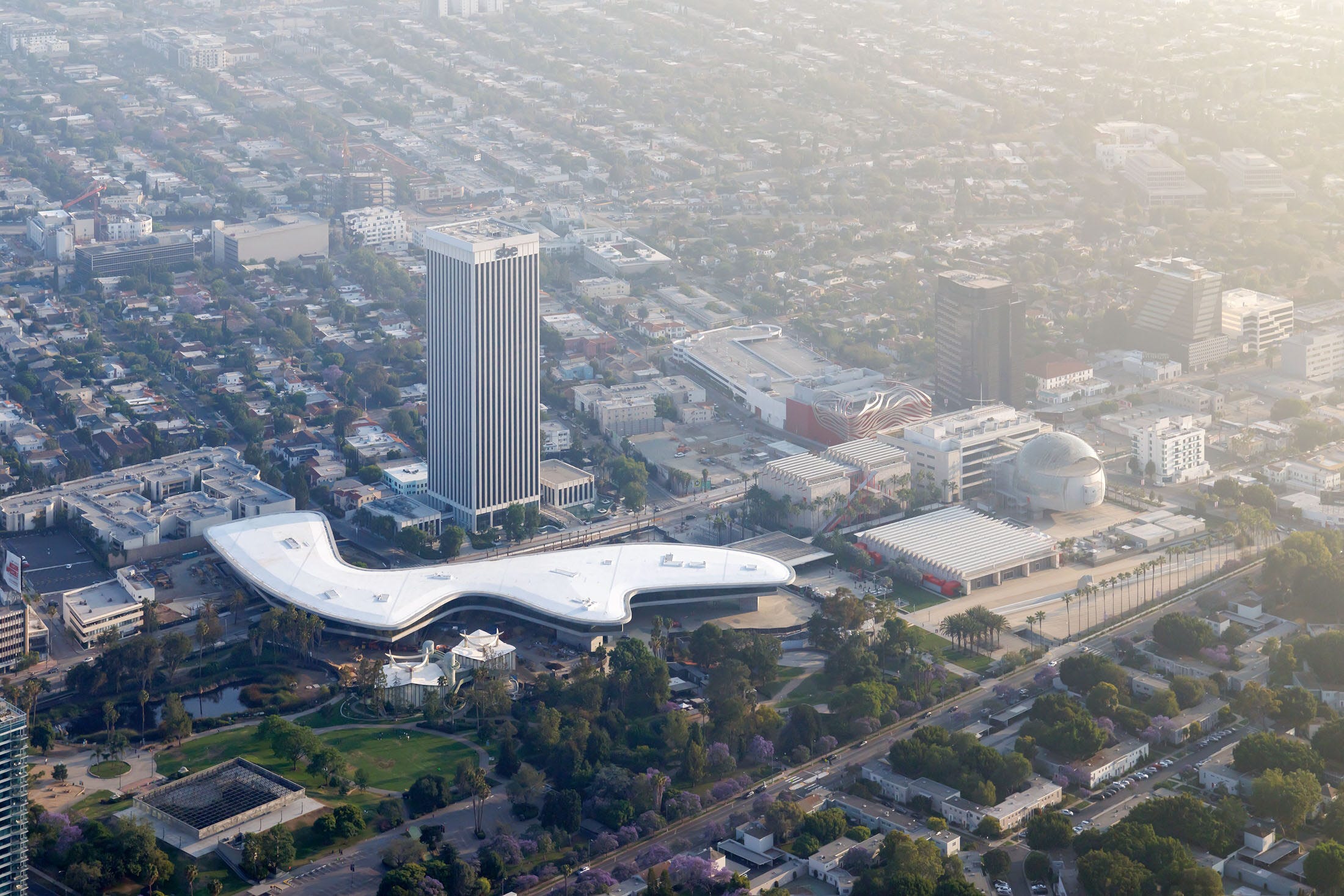
All the while, the corridor has continued to grow and densify. Its eastern side — Koreatown and Westlake — are the densest neighborhoods in the country outside of NYC. The entire route connects multiple high-rise-heavy job centers: Downtown, Koreatown, Miracle Mile, Beverly Hills, Century City, Westwood. And the just-opened stations are anchored by a cultural district that includes not only dozens of museums and galleries, but LACMA’s acclaimed and brand new campus. (Evidently, to some less trained eyes, Pritzker-winner Peter Zumthor’s design looks like a mere blob.) Urbanism, especially in Los Angeles, comes in all sorts of delightfully unexpected shapes and forms.

New Mobility, New Mentalities
The value of this new rail isn’t just the tunnels and stations, it’s the way it makes the existing mobility network that much richer and more effective. Imagine you live in Mt. Washington, a hilly neighborhood northeast of Downtown, and work in Beverly Hills. That’s a drive that could take as long as an hour and a half during the afternoon rush, now flattened to an easy 17 minutes on the A line and 15 minutes riding the D.
Even for commuters who don’t live within an easy walk of a rail station, having a regional backbone of high-quality transit unlocks an entire world of rich new mobility solutions for the first and last mile. Ride your bike, take a Waymo or Uber, hop on a shared scooter or public bikeshare, use an electric shuttle…
When you invest in the infrastructure that makes new mobility truly work, the possibilities are endless.
HOT INDUSTRY NEWS & GOSSIP
Seeing green: Micromobility heavyweight Lime just filed for an IPO, revealing that last year it lost $59M on $887M in revenue. While it's targeting a $2 billion valuation, the company needs fresh cash to pay off hundreds of millions in debt that’s due by year’s end. Industry watchers may recall that Lime touted positive free cash flow in FY24, but it sounds like that was based on clever asset financing that’s now about to come due. Meanwhile, the company is angling to expand deeper into NYC.
A capitol idea! Amazon is expanding its e-cargo bike pilot to D.C., deploying 15 equads with the participation of both DSPs and DDOT. While the NYC deployment uses hardware from Mubea and Scoobic (see my earlier review) this one looks to be using Fastport Honda vehicles (see my other earlier review.) In non-pedaling news, Amazon Now is bringing 30 minute or better deliveries to Atlanta, DFW, Philly, Seattle, Austin, Houston, Minneapolis, Orlando, Phoenix, Denver, Oklahoma City and more.

Sounds bumpy… Caltrans is studying the concept of running high-speed buses on California’s highways. I-80, I-5, U.S. 101 and SR-99 are all being researched for buses that could theoretically go as fast as 140 miles per hour, once a zillion other concerns are satisfied.
More, more MOIA: Hopefully you saw them at Curbivore 2026 first, but now MOIA’s robotaxis have begun on-street testing in LA. The VW subsidiary also just announced a partnership with Beep to scale up to 5,000 vehicles in shared ride formats, starting around Orlando.
No Seattle freeze? As the Emerald City and ridehailing / delivery apps continue to duke it out over pay and labor standards, Seattle has released a new set of data, making the case that demand has stabilized even as worker pay has increased. (See background on Pay UP and Fare Share.)

Just keep yankin’ on levers to see what else you can break… With the war on Iran and gas prices showing no signs of abating, President Trump has proposed suspending the federal gas tax. How might we pay for any transportation improvements? Well don’t worry, the administration also wants to end all funding for multimodal transportation and rail improvements. Meanwhile, Secretary of Transportation Sean Duffy has been on a seven month “road trip” to film a reality TV show, which was funded by the organizations (Boeing, Shell, Toyota, etc) that he purportedly regulates. Here’s the pitch deck, if you’d like to see how cheap a legal bribe is these days.
Beautiful buses: While transit agencies like NJT continue to take heat for their high game-day fares (now reduced to a cool $98,) LA Metro is offering rides for $1.75 (but it’s the parking that will cost you!) The agency just revealed its multi-county, high-frequency bus network for World Cup Enhanced Service. Expect something similar for the Olympics (which we discussed at Curbivore 2026.)

Driven by 2028 — Transatlantic Sustainable Mobility Forum: Hosted by the German American Chamber of Commerce, this morning forum brings together German mobility innovators and LA stakeholders to tackle a defining question: how to move millions of people, goods, and services across a sprawling city ahead of the 2028 Summer Olympics. The program includes keynotes, pitches from cutting-edge German companies and a panel on logistics and last mile for LA 2028, and features MobilityVC’s Sam Baker. Register for the May 19 event in DTLA.
A few good links: Hertz’s revenue pops 11%. LA Metro scores $150M in federal funds for Vermont BRT. Brightline teeters near insolvency. After years of solar investments, Spain now has one of Europe’s cheapest power markets (all hail the Spanish century!) Uber and Santander partner on €1 billion fleet financing initiative. NHTSA probes Avride. Grab Q1 revenue soars 24% YoY. Donkey Republic revenue climbs 9.9%. Kodiak AI stock slides after it raises $100M at a deep discount. New analysis of transit ridership show that Baltimore, Atlanta and Pittsburgh have had the worst post-pandemic recoveries. GM axes 10% of its IT department as it retools around AI skillsets. San Diego looks to limit state-mandated transit-oriented upzoning to just 16% of eligible land. Waymo recall reveals that AV fleet size now sits at 3,791. For the venture fund fundies: Yale Budget Lab proposes closing carried interest loophole. Maryland lays final piece of track for Purple Line. Rivian spinout Mind Robotics raises $400M. SF unveils new parking apps. What happens to Latrobe, PA’s airport with its only airline, Spirit, now out of business?
Don’t forget to join us in Detroit on June 9th for our next Urban Autonomy Summit.
- Jonah Bliss & The Curbivore Crew