


Los Angeles is many things, but it’s definitely a town where diffuse power structures make it difficult to build political movements. That’s doubly true when you’re asking both local citizens and elected officials to buck the status quo, and reconsider how they get around the city. That’s why Streets for All’s success at building a coalition for safe streets and multi-modal transport systems is so inspiring, while ideally serving as a template for similar movements nationwide.
In today’s podcast, I chatted with Michael Schneider, the organization’s Founder & CEO about how to replicate his group’s success, what it took to get measure HLA passed (including lots and lots of money, something he credits to his days as a startup founder,) why LA is still struggling to reshape its streets (hint: it’s also about money, or the lack thereof) and a few wonkier topics like charter reform.
Also on the pod: Greg, Athena and I dive into gender inequity across transport, eVTOLs taking off, World Cup transit troubles, super fast fundraising, Curbivore’s latest speakers and more. Listen in!
PARTNER | Rideshare Prices Up 9.6%, Platform Fees Surged 33%, Driver Pay Up Just 3.6%. Here’s What’s Reshaping Gig Mobility.

Download the 2026 Annual Gig Mobility Report from Gridwise Analytics to understand how pricing, earnings, tipping, and platform economics evolved across major U.S. rideshare and delivery platforms.
Our findings include:
Customer prices rose 9.6% while platform fees per trip surged 33.2% and driver gross pay per trip grew just 3.6%
Rideshare tips hit a record high of $1.58 per trip while delivery tips fell to $4.16, near an all-time low
Over 60% of consumers say they cut back on rideshare due to pricing, up 16.6% from the prior year
Consumers are rapidly shifting to more premium ride types, with Comfort, Black, and Priority jumping 10%, 35%, and 319% respectively
Driver bonus pay reached a three-year high of $317.65 per quarter
Download the full report to see the complete picture of where gig mobility economics stand today.
HOT INDUSTRY NEWS & GOSSIP
Air taxis take off, look out below! The FAA approved eight pilot programs, allowing companies like Archer, Beta, Joby and Wisk to start testing eVTOLs that have yet to receive full certification. The tests will take place in 26 states, with participation looking less political and more based off of which regions have existing aerospace economies.

Self driving, self funding? AVs are in land-grab mode in more ways than one. China’s Momenta just filed for an IPO on the Hong Kong stock exchange, joining compatriot WeRide in tapping the public markets in their insatiable quest for cash. The company is likely to raise $1B+, having last raised privately last fall at a $5B valuation. This will be a nice exit for GM, which invested back in 2021.
LAXluster: LAX, everyone’s favorite airport, just voted to raise fees for ridesharing trips, which are currently $4 (on the low-ish side compared to other major airports.) Under the new plan, drop-offs in the central terminal area will eventually reach $12, while those connecting to the new SkyLink would be $6. Beyond raising revenue, the program looks to shunt traffic to the soon-to-open automated people mover, or encourage folks to take Metro.
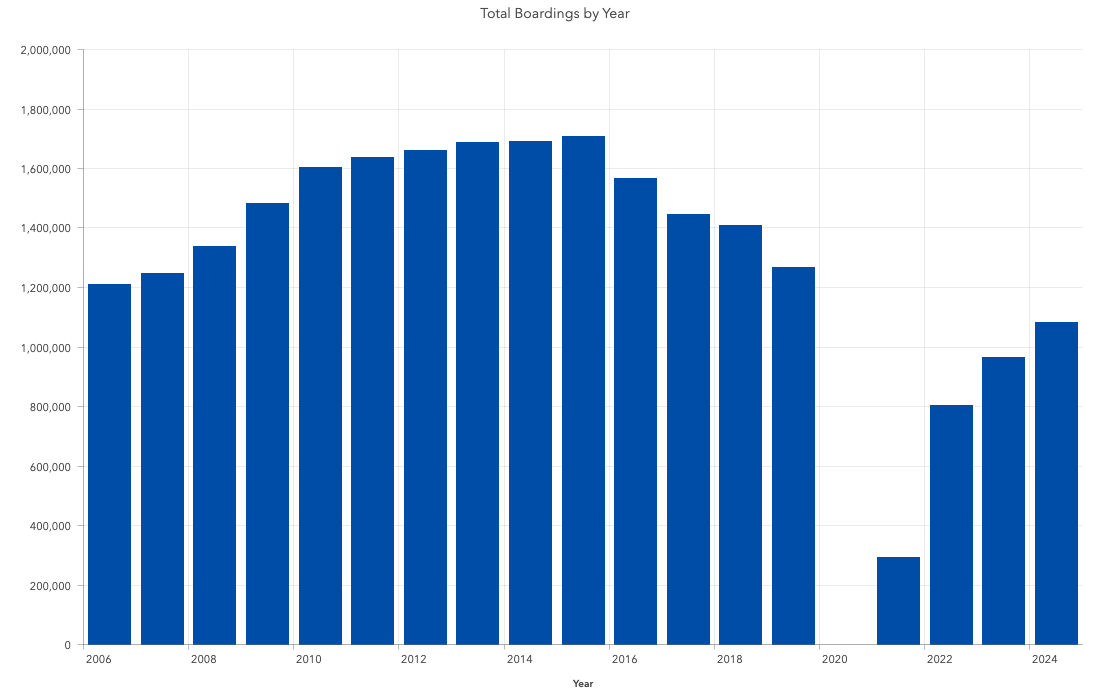
Which way, San Jose: In 2022, San Jose, CA adopted a “transit first” policy, opting to get techies onto public transit. First the good news: mass deployment of transit signal priority (powered by Lyt) has increased bus speeds by 20%. And the bad: while that has helped transit ridership rebound a bit from its Covid nadir, the remote-work friendly region still rides busses and trains about 40% less than it did at peak.
Permit reform: San Francisco just gave the “okay” to curbside EV charging, in a boon to both EV owners and industry friends like It’s Electric. This comes as part of Mayor Lurie’s “common-sense” reform to PermitSF, which also includes expediting al fresco restaurant dining (yay,) deck repairs (okay,) and parking in driveways (boo if this means more cars encroach the sidewalk.)
Ad nauseam: It’s a mantra around these parts that the real money makers for many mobility or delivery networks are those juicy, high-margin ads. But what works at scale for the network is a bit less compelling when you break it down on a per-person level. New data out of NYC shows that the annoying seat-back TVs that blare commercials in the back of many Ubers and Lyfts only net the drivers an extra $30-35 in profit per month. Frankly, I’d pay that much just to turn the screen off.

Talk about an incentive! Just how important is the success of Waymo and Wing to Alphabet? New filings show that Sundar Pichai, the company’s CEO, could get as much as $175M in stock-related performance grants if those subsidiaries meet performance goals.
Doge’d: Economic growth has slowed across the country, but some areas are feeling it worse than others… The Washington, D.C. region is at the bottom of the list — down 1.7% YoY — due to the current administration’s hatcheting of the federal workforce. Overall, many (but not all) of the strongest growing regions are the most sprawling and low-density, further complicating any goals to re-grow CBDs and get folks back on transit.

A few good links: Uber eyes subscription pricing for drivers. VW delivers four millionth EV. Politickin’: Gov. Hochul’s pause on NY robotaxi pilot likely done to build allies for insurance reform. California cracks down on Montana license plate tax fraud. Free transit gains momentum in France. Talk about a carbon tax: illegal war with Iran pushes oil prices to $100/barrel. Zoox begins robotaxi testing on the hot asphalt of Phoenix and Dallas. Minnesota may quash AVs. Coco Robotics deploys Niantic’s spatial AI and Visual Positioning System. Public transit investments have a 5 to 1 ROI. Digital curb management providers still struggling to keep an eye on scofflaws. Ridehail drivers in LatAm struggle without safety nets. Serve Robotics partners with White Castle, sees FY25 revenue hit $2.7M. Congrats to Pritzker winner Smiljan Radić. Grubhub / Wonder partners with Dexa (fka Drone Express) to pilot aerial delivery in suburban New Jersey. Zoox to bring Las Vegas and LA robotaxis onto Uber network. With the Senate passing the ROAD to Housing Act, an economist explains why banning investors from owning single-family homes might not be so smart. How metro systems pull commuters out of cars. Swarm Aero raises $35M for drone swarms. Victoria, Australia enshrines two-days of WFH per week for all workers. Why we can’t build modular homes. Nissan, Uber and Waybe collaborate to bring robotaxis to Japan. Ford’s new AI assistant will notify fleet owners about seatbelt usage. Rivian launches more affordable R2. NYC looks to finally charge for residential on-street parking; why has this taken so long?!
Don’t forget to score your Curbivore tickets, price jump tomorrow!
- Jonah Bliss & The Curbivore Crew


