

After decades of hype, autonomous vehicles are finally very much real. Driverless trucks are hauling freight across Southwestern highways; delivery bots are doing rounds in metros as varied as Malmo and Miami; and robotaxis are plying the roads of mega cities and podunk towns alike. What’s not yet decided is how far, and how quickly, these services will scale, as society grapples with a mix of policy, technology and capital market questions.
Whether AVs ramp up to five or 50% of mode share, I think the more interesting questions are actually about what comes next… what are the second order effects of the robotaxi revolution?
What will the rise of self-driving vehicles mean for the drivers that currently work in ridehailing or as cabbies? Even in the most optimistic deployment scenarios, AVs are capital intensive, so their scale will cover base demand, not peak. In that case, might TNC drivers go back to the earlier premise of gig work, and just log on for a few hours of supplemental earnings during rush hour?
What happens to urban real estate, both public and private? Why waste valuable land on car storage, if the car can take itself off-site while you’re shopping, or better yet: pick up its next passenger. Can those spots then be repurposed as outdoor dining, parks, or homes? Will they become charging depots for power-hungry vehicles, or will we have instead decided that all our spare grid capacity should be spent on AI server farms?
Will restaurants and retailers thrive in a world where self-driving trucks cut down their input costs, and sidewalk bots give them some breathing room on delivery margins? Might those gains help independent shops compete, or will well-funded chains be better able to capitalize on these advancements?
If the price of ridehailing falls, might more people eschew car ownership, opting to only pay for mobility when they use it, thus enjoying a broader array of transport options? That was more or less our conceit when we created Turo: people would use and pay for cars just when they needed them, and then opt for other mobility modes — transit, biking, etc — at other times. Suffice to say, making car usage cheaper only led to people using more cars…
While AVs scale up, some of the remaining questions are technological in nature, but I think even more are actually policy questions. If we don’t want everyone stuck in (self-driving) traffic, might more cities opt for congestion pricing? What happens to parking meter revenue in a world where nobody needs to park?
Questions like these are vital, and they’re at the heart of the conversations we’ll be having at Curbivore 2026. We’ve assembled a truly top notch cast of speakers, we’re bringing together the smartest companies building the future (meet more of them below, or skip to the bottom if you want the weekly news) and we’ve got all the technology of tomorrow right on display. Join us April 16-17 in Downtown LA.
MEET CURBIVORE’S LATEST PARTNERS

TaskUs delivers outsourced digital services that power the companies shaping the future. By combining specialized human talent and intelligent technology, we solve complex operational challenges through a unified ecosystem of specialized services — from L&D to R&D, remote and emergency assistance, in-field and mission control operations — reducing cost-per-mile and enhancing rider experience while ensuring uncompromised safety and compliance.
Wombi offers a premium, all-inclusive e-bike subscription. Memberships include theft protection, 24/7 Rider Rescue, and the option to purchase your bike when the time is right. Ride with confidence knowing Wombi has you covered every mile of the way.
Serve is a leading autonomous robotics company operating a scaled, commercial, Level-4 fleet across 20 U.S. cities.
Voltera enables rapid AV fleet deployment through purpose-built, high-performance hubs in dense urban markets.
LAZ is a leader in tech‑enabled mobility and parking, delivering people‑first operations powered by smart technology — to help our clients build their businesses, not ours.
Mapbox is the location technology platform that powers billions of map, navigation, and search experiences worldwide. Trusted by developers and enterprises, from BMW to DoorDash, Mapbox delivers flexible, high-performance geospatial solutions that delight users, enhance operations, and transform industries.
HOT INDUSTRY NEWS & GOSSIP
A (self-driving) truckload of AV news: Fresh off relaunching its Motional robotaxi service in Vegas, Uber announced its investing up to $1.25 billion into Rivian to deploy tens of thousands of autonomous R2 SUVs. Meanwhile, the DOT is getting ready to allow mass-production of steering wheel and pedal-free vehicles. On the smaller side, Ottobot is taking its delivery bots to a remote Australian mining village, in partnership with Sodexo. And Uber ATG’s former Self Driving Lead documents all the inherent flaws with his self-driving Tesla that led to its crash.
Watch me talk about AVs and ridehailing! Can’t get enough snark, I mean analysis? I’ll be speaking at Roth’s 38th annual capital markets conference on Monday at noon PT. Register for the livestream of “Rideshare At Crossroads - Autonomy, Global Expansion, and the Next Phase of Mobility.”
Out of gas… Brent oil prices briefly cracked $119 this morning, while a gallon of sweet, delicious gasoline is now averaging out to $3.88 in the United States. Prior research shows that for every 10% increase in gas prices, transit ridership grows by 1.2%, so this awful war might be the most Trump has ever done to boost public transport.

Double dash: Two-wheeled deliveries are taking off on DoorDash, with growth of deliveries via bikes and mopeds scaling four times faster than car-based orders over the past two years. Two-wheeled couriers earn 10% more per hour than their automotive counterparts, thanks to less time spent parking and stuck in traffic. DD also just added a new category that requires zero wheels — Tasks — a platform for gig workers to add photos and data to enrich menus and AI training sets.
Here comes Amazon, quickly: Amazon is looking to eat some of DoorDash, Uber Eats and Instacart’s lunch, as it launches one-hour delivery of select inventory. The new $9.99 per order service is launching in major cities as well as mid-sized ‘burgs in the Mountain West, while a 3-hour option is headed to small towns nationwide.
New York two-step: NYC Mayor Mamdani is halting the NYPD’s crackdown on bicyclists, ending criminal summons for minor traffic violations, while also upping training for bike-based delivery workers. Meanwhile, his new Transportation Commissioner Mike Flynn is looking to relax permitting for outdoor dining.
Unsafe at any speed: New data from Streetlight shows that most of America’s streets are still far from safe. Pedestrian fatalities are on the rise, as metro areas — especially in the South — prioritize speed over safety.

Discondobulating: Condos should be a great way for America to combat its housing crisis. Affordable for builders and homeowners alike, while taking a naturally urban form. And yet we build far too few of them, thanks to an arcane mix of rules that favor litigation and slow planning / plot mapping.
A flagrant conflict of interest: Meanwhile, older condos are in trouble too. San Francisco recently wrote new rules that required older high-rise buildings to install fire sprinklers. Now the fire marshal who wrote the controversial rules has found himself a new job as a consultant that “helps” building condo associations comply with the $300k per unit requirements.
End of the line, once more: The Red Line — a long-planned east-west light rail line in Baltimore — appears to be on life support, with officials looking to replace the planned train with a cheaper bus rapid transit system. This line has died many previous deaths: a similar route was sketched as part of the region’s Great Society era subway system, of which only one different line was ever built; it was revived as light rail in the early 2000s, and then killed by Governor Hogan, before being revived by the current Governor.
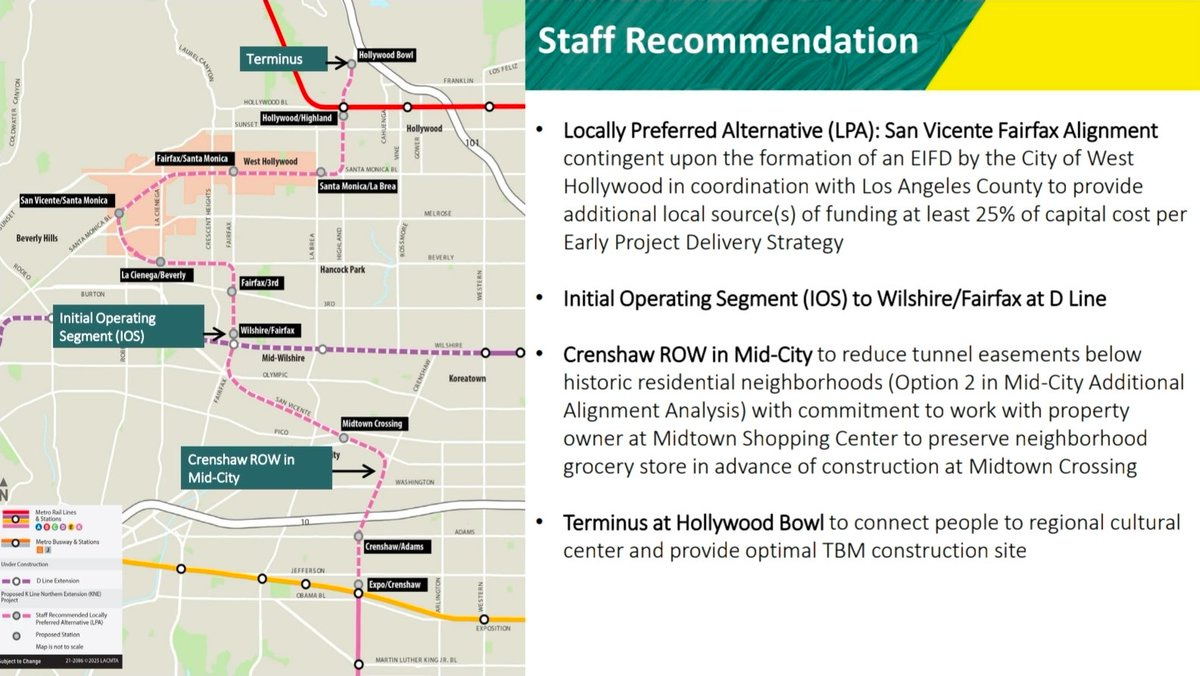
LA’s next, next subway: LA Metro has recommended the San Vicente-Fairfax alignment for the northern extension of the K Line, aiming to hit job and population centers across Mid-Wilshire and West Hollywood. The agency also appears to sadly be kowtowing to the dumbest NIMBY complaint yet — concerns that the deeply bored tunnels would somehow disturb single family home owners above — and may in turn choose a longer than necessary route in the Wellington Square neighborhood: that would both cost more to build and make service forever slower. In happier news, here are some beautiful photos of the D Line stations that open in two months.
Cool book alert: Friend of the curb Joshua Schank’s new book — New Tricks for Old Bureaucracies — is on sale now, hitting shelves next week. Score yourself a copy!
A few good links: Singapore cabbies raise fares as gas prices jump. LA break ground on tallest modern affordable housing project West of the Mississippi (35 stories, no parking.) Detroit Airport to host Michigan’s largest Supercharger site. IIHS / Volpe push for active intelligent speed assistance on fleets. Google Maps gets Geminied. Atoms. Prosus leads $600M round into Indian ridehailer Rapido. The problem with hacker house hype culture. Iceland transitions from gas tax to road user charge. Ex-Nikola CEO and convicted fraudster Trevor Milton plots his airplane-oriented comeback. Despite federal withdrawal, CA continues investing in zero-emissions transit. Immigration is good for local economies (duh.) Sony-Honda’s eye-catching (and troubled) Afeela 1 to be California-only for the time being. Eight lessons learned from the death of the D.C. Streetcar. Amtrak rail yard sale could lead to new Chicago neighborhood + White Sox stadium. Mexican city of Uruapan inaugurates aerial cable car. Congestion pricing leads to faster NYC subway ridership growth.
Don’t forget to score your Curbivore tickets!
- Jonah Bliss & The Curbivore Crew
Hi Jonah, great piece. The "what happens next?" questions are exactly what I spend my time on. My Substack explores these second-order questions around autonomous transport, particularly through a British lens, if any other Curbivore readers are curious.