

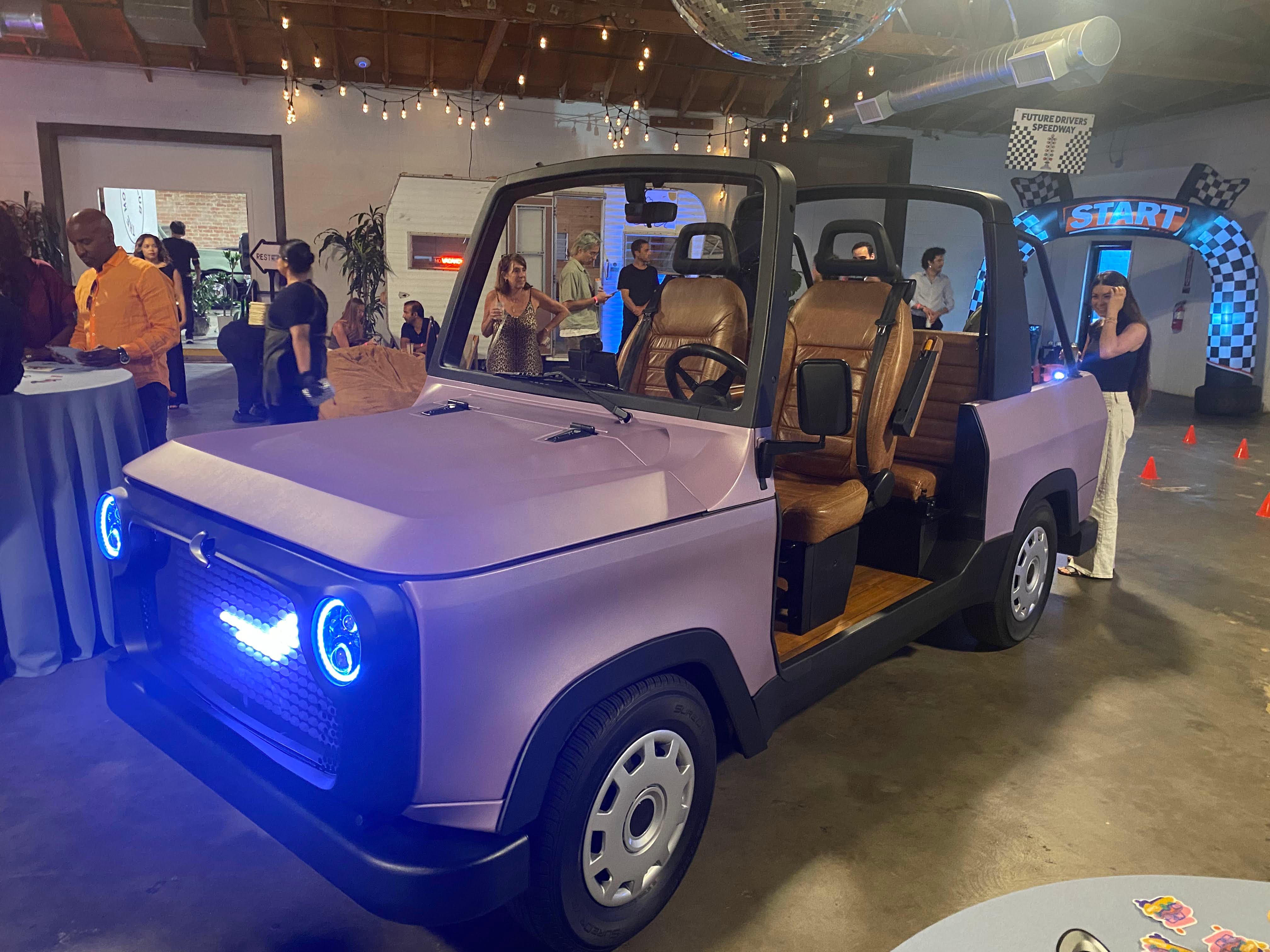
Last night I attended the launch party for Chip, a new vehicle made by the excellent hardware minds of Ilan Penn and Jameson Detweiler. As you can see in the launch video, they’ve checked just about every box an urbanist could want out of a vehicle: it’s cute and communicative, energy efficient, features remote driving and most importantly it’s small and affordable (retailing for about $15k.)
While the marketing leans into beachy use cases — throw on your surf board or bike and head to the boardwalk! — these neighborhood electric vehicles really should be perfect for anyone who just does in-city driving: it’s street legal on any road with a 35 mph or less speed limit. If you’re not hopping on the highway to grab coffee, pickup groceries or meet up with friends, why exactly do you need to get into a huge SUV?
The “NEV” category has existed for almost 30 years, and anyone that’s spent some time on a golf course community has likely seen folks puttering around in their GEMs on the neighboring streets. But lately there’s been a renewed interest in the segment; just last week, Stellantis announced its stylish Fiat Topolino will finally be heading stateside, while others like Infinite Machine are pushing souped up electric mopeds.
Getting Americans out of their oversized and overpriced cars isn’t going to be easy, but making the alternatives unique and stylish will certainly help convince consumers that there’s merit to going small. The more we can do to help enforce road safety rules — remember when we actually went after people that texted while driving or blew through stop lights? — the more we can get other road users comfortable in these vehicles as well. A big part of the reason that quadricycles are so much popular in Europe isn’t just that the cities are “old” but that they still actually enforce traffic laws…
HOT INDUSTRY NEWS & GOSSIP
Yeehaw! We’re excited to announce that the next edition of our Urban Autonomy Summit is headed to Austin on October 14th. Texas has emerged as a hot-spot for AV logistics, so we’re looking forward to deep conversations on everything from robo-trucking to drone deliveries. Reach out if you’d like to speak or sponsor.
Speaking of robotaxis… MOIA took its autonomous shuttle service live in Hamburg. Germany has been pretty slow on AV uptake, so this is a win not just for VW, but for other ecosystem players like MobilityVC-backed Motor AI. Coco’s autonomous delivery bots expanded to D.C.’s Logan Circle neighborhood; some competitors are just across the river in Arlington. Tesla claims to be building a wheelchair-accessible robotaxi. And Uber’s getting into the regulatory capture game, as it lobbies D.C.’s city government to require that any AV operators maintain a hybrid fleet also composed of human drivers.
Goal! With the World Cup wrapping up, we should give three cheers to all the transit agencies that impressively handled the visitors flocking to stadiums and the locals headed to fan zones. In LA, it’s served as a nice test run of sorts for the ‘28 Olympics, with Metro and other local agencies coming out looking well prepared. LA Metro saw ridership jump 9% YoY in June, and that’s not even counting riders on its special stadium-serving busses.

Uber Eats Delivery Hero: After a long courtship, Uber has officially unveiled its $14.8 billion offer for Delivery Hero; if approved, the deal will effectively double Uber’s global footprint. Uber Eats is also beefing up its offerings at home, having just signed new partnerships with GameStop and Foot Locker. Competitor DoorDash just launched an integration with Shopify, aimed at letting local retailers offer easy delivery.
Squeezed: Everee has a new report out looking at gig worker pay. While drivers are worried about EVs eating into their earnings, their more immediate concerns are around high gas prices. 69% of drivers say rising fuel costs have significantly or moderately reduced their earnings in the past three months, while over a quarter spend 25% or more of their weekly paycheck on gas.

Keep Austin weird(ly bad at building transit!) Austin Transit Partnership, the beleaguered semi-public agency trying to build light rail in Austin, just can’t get out of its own way. It just signed a contract to pay a whopping $16.8 million per light rail vehicle, more than double what Cleveland is paying (and even that one seemed expensive!) I caught up with Jack Craver, who runs the Austin Politics Newsletter, who notes:
“It’s been heartbreaking to watch such a promising transit plan get eaten up by cost disease. It’s hard to know to what extent the problem is due to factors outside of ATP’s control, but it’s very hard to be optimistic about Austin’s transportation future when it takes this much money to build such a puny piece of infrastructure.”
Good street, okay street, bad street: Lisbon is working with ETH Zurich and Bolt to allow its citizens to “trial” new street designs, before the Portuguese capital permanently reallocates road space for non-auto users. Meanwhile, Vital City is making the case that NYC should take ownership of its sidewalks (a nice idea in practice, but this is a big part of why LA’s sidewalks are such a mess.) And speaking of LA, the city just agreed to pay out $20M to the family of someone killed at a missing crosswalk. (Perhaps its time the state reins in nuclear verdicts against the public sector.)
Birds of a feather… Flock Safety’s camera network wrongly tracked an automotive journalist, resulting in a dangerous police raid. Meanwhile, the LAPD is ending its contract with the company, citing “serious concerns” about the how the camera operator handles civil liberties and privacy.
Taking off: A new BloombergNEF report looks at how important airports have become for ridehail services, which is why robotaxi cos will most certainly want access to those juicy curbs. While SFO, LAX and JFK each had nearly 10 million trips, it sure looks like the latter two have some room to jack up their PUDO fees…

A few good links: Wonder raises $650M at $9B pre-money valuation. Miami set to cut bus routes, further defer potential rail extensions. EV chargers growing fast in the South. Singapore completes Circle Line. Manna picks Tulsa as U.S. drone hub. Bipartisan housing law goes into effect. Waze adds AI-powered features, motorcycle functions. Lyft names Senthil Padmanabhan as CTO. Germany wants to hold micromobility companies liable for damages caused by users. Michigan’s MIX Summit returns on 9/17. St. Louis Metrolink to ask voters if money earmarked for light rail can be redeployed towards BRT. Lucid Motors denies bankruptcy rumors. Sheryl Sandberg and DVx invest in Self Inspection. BP shutters corporate venture arm, as it retreats from cleantech. Jacksonville’s sorta-self-driving shuttle service NAVI is on the rocks, while the transit operator’s CEO heads to a new gig in Dallas. Greylock raises $1.5B early stage fund. Women-only taxis take off in Finland. Everyone agrees spaced-based data centers are not happening. NYC’s new Public Interest Technology (PIT) Crew aims to help make tech pilots permanent. Win-win: Manhattan to lose parking spaces as city installs more trash bins. LA People Mover construction consortium sues city; why oh why did the airport award some of these same contractors its dumb roadway project. Bolt adds London-based Hiyacar’s p2p carsharing to its app. Bliq approved for AV testing in Finland.
See you next week!
- Jonah Bliss & The Curbivore Crew