

Gorillas, Fridge No More, Milkrun, Buyk, Food Rocket, Weezy… half a decade ago, the world was filled with a smorgasbord of instant-delivery startups. Buoyed by homebound pandemic sufferers, ZIRP-fueled investments and seemingly differentiated by little other than stupider and stupider names, these companies flooded urban streets with fast-driving couriers racing to get candy bars to consumers in fifteen minutes or fewer.
While savvy consumers lived off VC-subsidized groceries, many cities briefly suffered the consequences. In the dash to meet these ultra-fast SLAs, couriers would often ride against traffic or on sidewalks, endangering locals. In a bid to saturate neighborhoods with local depots, all sorts of properties were turned into dark warehouses, often out of compliance with neighborhood zoning.
And then, just as suddenly as they all cropped up, these q-commerce companies began to wither away, the bubble popped by central banks raising interest rates above zero-ish percent. In the U.S., this started just over four years ago, right around the time that JOKR’s COO Aspa Leka spoke at Curbivore 2022 (oops!)
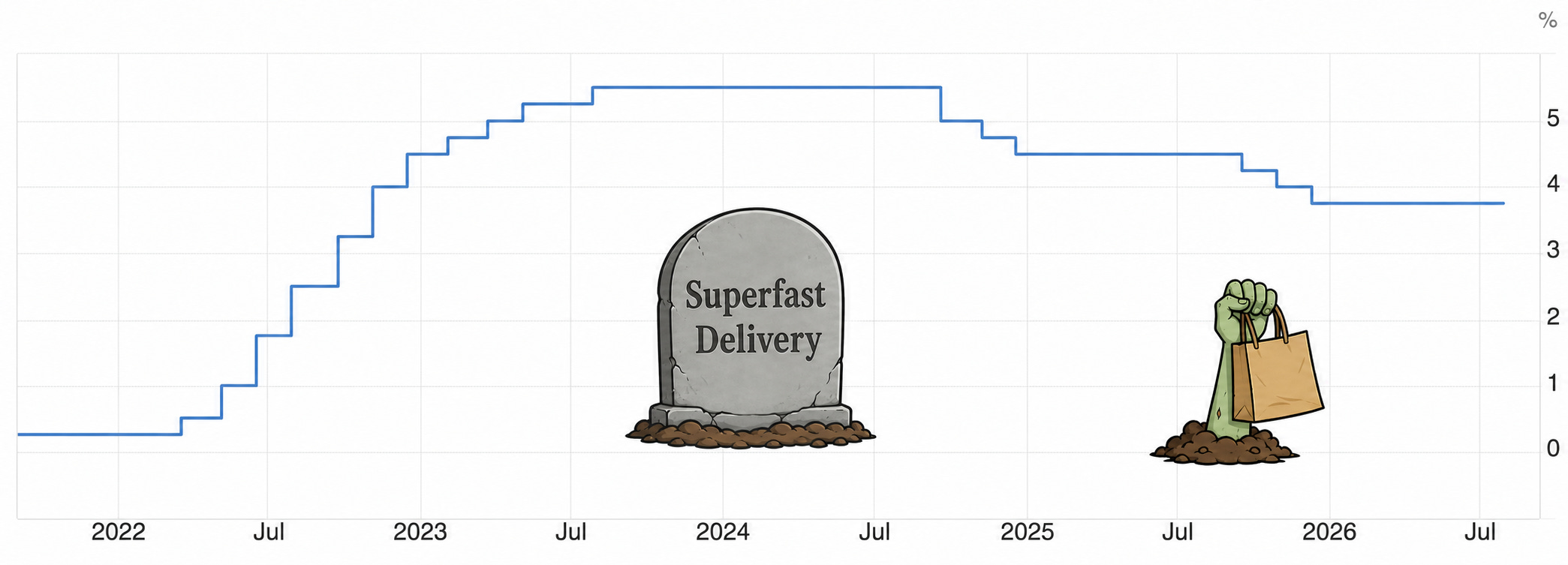
In truth, it was more a retrenchment than a total extinction. Players like Getir and JOKR retrenched to Turkey, Brazil, India and the Gulf, all countries with the necessary mix of relatively wealthy urban consumers and a teeming labor pool of couriers who would work fast (and cheap) enough to make the economics stick.
In the U.S. and E.U., the business model was coopted. In Europe, delivery networks like Delivery Hero started opening its own dark stores, tapping into the existing consumer demand from their restaurant-related operations. In the U.S., we’ve seen Walmart, Amazon and regional grocery chains pick up the pieces, using their existing infrastructure to compete over 30-minute, or faster, deliveries.
And in just the past few days, a new slew of developments portends the return of even more instant deliveries: Grocers like Hy-Vee and Tesco dramatically expanded their 20-minute operations; Atoms just raised $1.7 billion, with a pitch that’s all about speed and automation; Indian mega-deliverer Blinkit is finally on the verge of profitability, and a new report highlights just how hungry consumers are for instant convenience.
Over at Modern Delivery, I’ve broken down each of these stories, highlighting how it all adds up to the raucous return of rapid delivery. This time, let’s hope cities are ready!

HOT INDUSTRY NEWS & GOSSIP
Delivery drones take off: DoorDash continues to up its hardware ambitions, with co-founder Stanley Tang announcing the launch of DoorDash Air, an FAA Part 135 certified drone operator. This might turn up the heat a bit on existing partners Manna, Flytrex and Wing. Speaking of those latter two, Wing and Walmart are expanding their ops in Florida, while Flytrex and Nash are collaborating on an order management system to route activity to mixed fleets. For context, rewatch Stanley Tang, Wing CEO Adam Woodworth and Coco CEO Zach Rash at Curbivore 2025.
Gadzoox! Amazon-owned Zoox finally received federal regulatory approval to begin paid robotaxi deployments, after about a year of only being permitted for unpaid trial rides. The exemption caps the Zoox fleet at 2,500 vehicles for two years; Zoox says Vegas will be the first market to go paid. Meanwhile, lawmakers are pushing for new federal AV standards.
Destination unknown: Seems like a lot of tech partnerships are on the rocks this week, as Waymo and Uber consider dissolving their partnership amidst “diverging objectives” and warring policy goals. Waymo just announced plans to launch its own app in Atlanta and Austin, markets that previously required AV riders to use Uber. (Waymo pulled its fleet from Uber’s Phoenix operations in May.) Meanwhile, Lyft has partnered with Baidu’s Apollo Go, beginning tests on London streets with “dozens” of vehicles. During my recent visit to the U.K., I was surprised by just how many Chinese vehicles were on the streets, but I suppose Britain basically has no domestic automaking economy left to protect.

Speaking of protectionism… Not content with having kicked out Polestar, the U.S. Senate is adopting new legislation that would further ban Chinese-linked cars from America. One of the passed bills appears to ban Mercedes-Benz, due to an existing passive Chinese investment into the German OEM. Expect auto prices to keep rising as manufacturers are forced to find new suppliers for select components. The ban hammer has also just been extended to foreign-made humanoids and quadrupeds.
This is why your train is delayed: The APTA published a response to the USDOT’s draconian proposals for public transit funding, which include eliminating the Highway Trust Fund’s Mass Transit Account. Meanwhile, the Trump Administration has refused to spend billions that congress has already allocated for transit. But at least there are plans to rename NY Penn Station after the President, phew! And in cuter news, subway service in Hong Kong has been repeatedly suspended due to monkey intrusions.
Land use, delicious land use: The drive-thru restaurant was arguably invented in Los Angeles in 1931, with burger icon In-N-Out evolving the concept towards its modern form a few years later. While the format prioritizes automotive convenience, it can have deleterious effects on nearby pedestrians and even other motorists. Now the SoCal city of Culver City is considering banning drive-thrus, joining a small list of other ‘burgs that have stood up to Big Hamburger.
The map is not the terri-yaki-tory: DoorDash has updated its fee structure, so that further away orders are likely to cost more. This will subtly improve traffic, as the old system really had no way of signaling that your burrito might be coming from 9 miles away. Overall, delivery fees have dropped meaningfully in the past year.
NYC shenanigans: Yet another rideshare startup wants to challenge the Uber-Lyft duopoly — meet Throo. While the company is looking to pick up drivers by promising a smaller take-rate, it appears to instead ask riders to pay a fixed platform fee, which will certainly make consumer uptake difficult. Meanwhile, TNC scofflaw Empower is in trouble for skirting congestion fee surcharges. And the MTA has unveiled plans to fix up problematic interlockings that routinely delay subway service, although it looks like this will reduce the number of one-seat rides from point-to-point.

The BAT signal: Our friends at LACI BATWorks have launched their Cohort 11 Pilot Applications. Backed by a $100M city investment, BATWorks offers climate tech innovators the space, infrastructure, and ecosystem support they need to prove and scale technologies, on the Brooklyn Waterfront.
Politics ain’t beanbag: An LA Superior Court judge ordered Waymo to stop overnight charging at two hubs in Santa Monica, in a victory for city officials, while the AV co. claims the city ordinance violates an earlier agreement. Remember, robotaxis don’t vote…
A few good links: Tesla builds 10 millionth EV, while India’s River rolls off 500,000th e-moped.. TK-helmed Atoms raises $1.7B, looks to have abandoned plans to buy Chinese AVer Pony AI. Dott reports €47M in Q2 net revenue. Oklahoma City voters mull commuter rail proposal. Toyota and Uber expand access to EVs for ridehailing in Europe. Waymo collects thousands in parking tickets across Austin. Ford picks Apple Maps. Upshift partners with Autzu on AV hubs. The Boring Company seeks new funding at $20B valuation; while in other boring news, tunneling for the Swiss-Italian Brenner Base Tunnel is completed. Taiwan approves HSR extension to less-populous east side. Lés nimbÿs — Swiss petrol station owners delay tram extension. Li’l car, big competition: China’s BYD enters Japan’s electrified kei car segment. Penske sells 5% more cars in Q2. A very oily mystery: China appears to have drawn down hidden petrol reserves, tempering global gas prices. It would be nice to go back to enforcing basic laws in the public realm: California restaurateurs complain that street vendors have an unfair advantage. Despite EV charger shortage, Florida plans to redeploy NEVI money for eVTOL landing pads. Spurred by Tesla issues, NHTSA considers new car door handle regs. Never trust the consultants: PwC reports on EVs and AI found to be riddled with AI-generated nonsense.
See you next week!
- Jonah Bliss & The Curbivore Crew